
 Products


| Quantity: | |
|---|---|


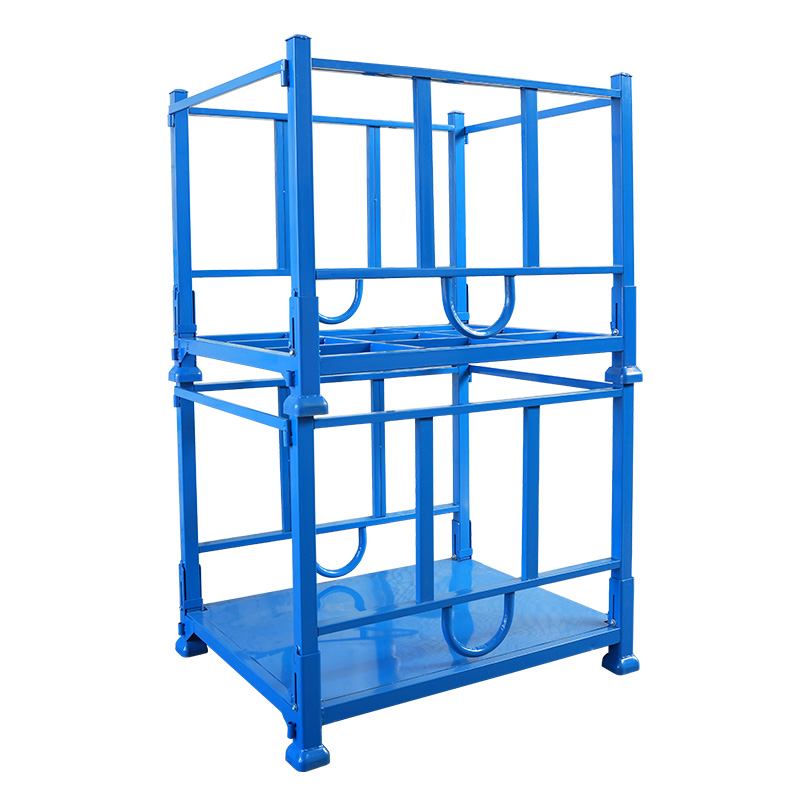
Collapsible stacking racks (also known as folding stack racks or foldable stackable frames) are unitized storage and turnover devices designed for multi-layer stacking and compact folding. Comprising a pallet-style base and collapsible uprights/frames, they represent the foldable variant of traditional stack racks.
Core Material: Primarily constructed from welded Q235 cold-rolled steel, featuring a surface finish of powder coating or galvanization for corrosion and rust resistance.
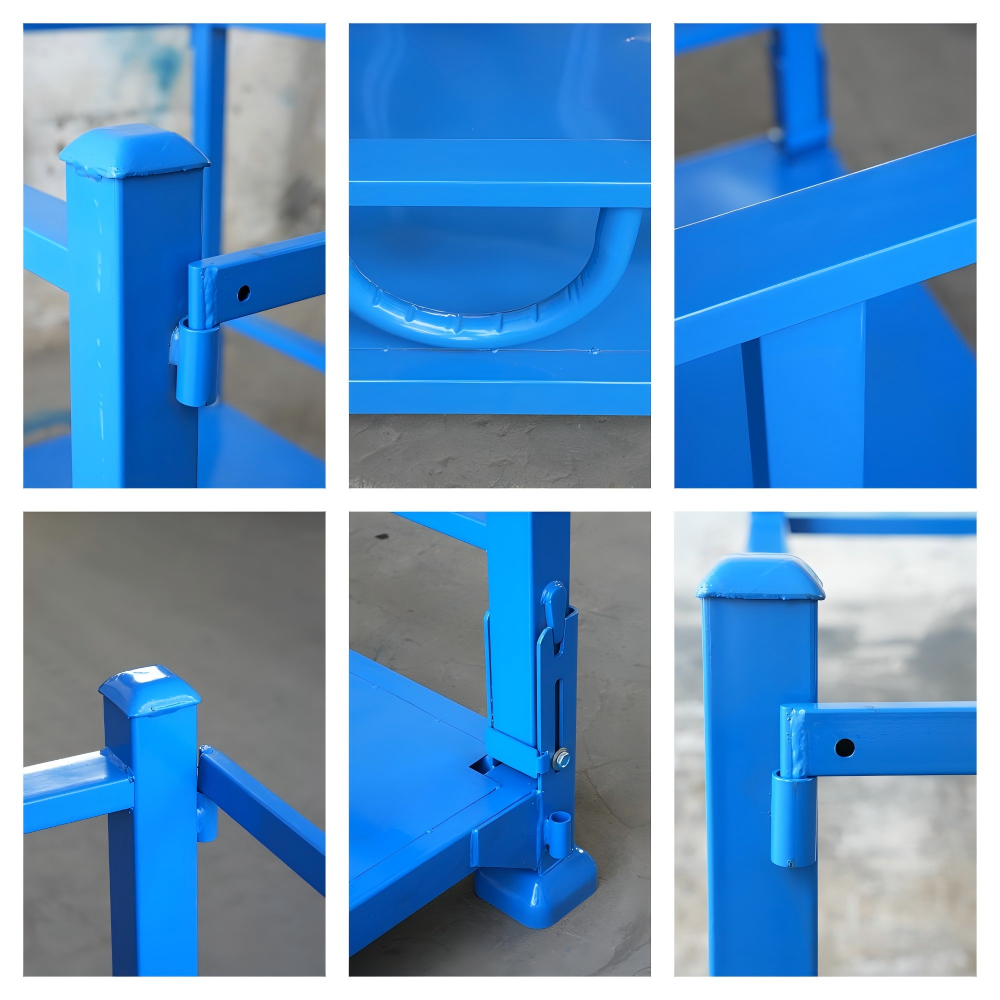
Structural Features: Features an interlocking design with top tenons fitting into bottom grooves, allowing for secure stacking without the need for fixed fasteners; the uprights/side frames can be rapidly folded down, reducing the rack's volume when empty to 1/3 to 1/2 of its original size (approximately 300mm in height).
Specifications: Standard dimensions include 1200×1000mm and 1400×1200mm; individual layer load capacity ranges from 500 to 3000kg, allowing for stacking up to 3 to 5 layers high.
Applicable Scenarios: Factory temporary storage, logistics transit hubs, cold chain warehousing, seasonal inventory management, rental warehouse operations, and workshop material turnover.
- Enables vertical stacking up to 3–5 layers high, boosting space utilization by over 300% without the need to rely on fixed shelving systems.
- Features an aisle-free design, allowing for high-density placement directly against walls.
- Allows for quick, one-step folding when empty, significantly reducing the floor space occupied by idle racks and cutting transportation/storage costs by over 50%.
- Facilitates easy relocation and facility transfers, as racks can be stacked for transport without requiring disassembly, allowing for rapid redeployment.
- Compatible with forklifts and stackers for four-way entry, integrating "storage + handling" into a single seamless process and eliminating the need for secondary transshipment of goods.
- Features uniform specifications and fixed capacities, ensuring goods are clearly visible at a glance and facilitating efficient inventory management.
- Triangular reinforcement via uprights and crossbeams; interlocking stacking mechanism prevents tipping and ensures stable load-bearing capacity.
- Optional guardrails, stopper bars, and base plates are available to prevent cargo from tilting outward, sustaining compression damage, or falling.
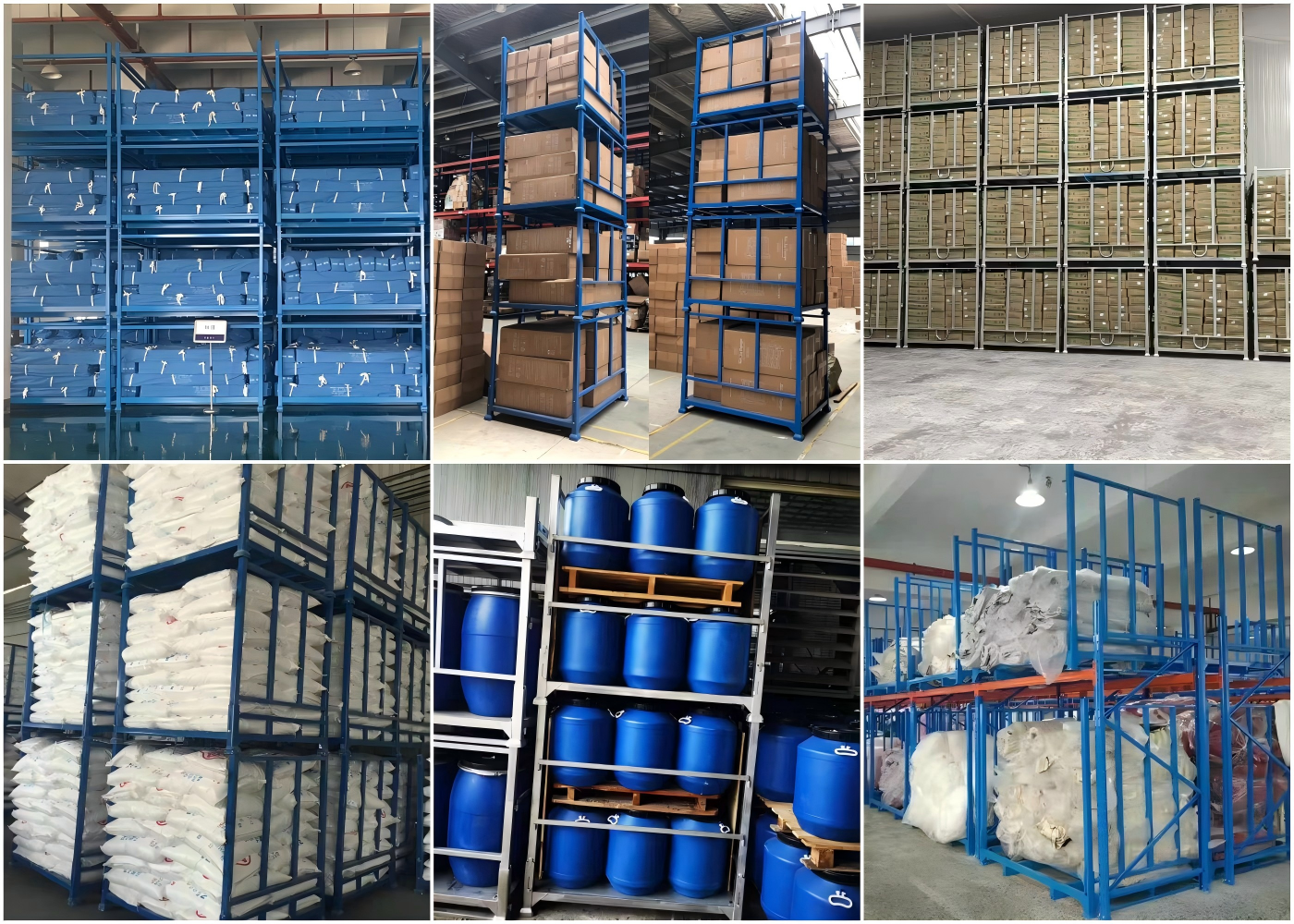
- Compatible with standard pallets (1210/1310); suitable for storing uniform cargo such as boxed goods, drums, bagged materials, tires, textiles, etc.
- Freestanding placement requires no installation; ideal for temporary, short-term, or seasonal storage needs.
Foldable when empty to significantly reduce the footprint of idle equipment; enables multi-tier vertical stacking to fully utilize warehouse vertical space.
Requires no installation—simply unfold to use and fold up for storage; adaptable to various scenarios such as temporary warehousing and seasonal inventory stocking.
Features a four-way fork entry design compatible with various material handling equipment, enabling seamless, one-stop storage and transport of goods.
Constructed from high-quality steel; highly resistant to impact and abrasion, with anti-corrosion surface treatment suitable for diverse warehouse environments.
Reusable and recyclable; requires no additional warehouse structural modifications, thereby reducing storage and transportation costs while simplifying inventory management.
Features a tight, interlocking stacking mechanism that resists tipping; effectively protects cargo and prevents scattering or damage caused by compression.
Unlike fixed shelving systems, its volume is significantly reduced when folded (while empty), making storage and transportation much more convenient.
Compatible with standard pallet dimensions; versatile across different scenarios and facility sites, facilitating standardized warehouse management.
Features interlocking upper and lower positioning mechanisms to prevent slippage or tilting during stacking, ensuring safety even in high-level storage configurations.
Combines storage, turnover, and stacking capabilities, accommodating a wide variety of goods such as boxed, barreled, and bagged items.
Can be fitted with optional accessories—such as dividers or guardrails—as needed, meeting the specific storage requirements of different types of cargo.
Stacking rack is a type of shelf, and it is also a unit type movable shelf. Stacking rack is an enlargement of stackable column tray, suitable for storing large and small weight items. At the same time, smart racks can be stacked with each other, both for carrying and empty stacking. Its storage does not depend on the shelf, and is suitable for stacking and turnover of finished products with large storage quantity, single overall dimension, large volume, and light weight.
1. Unified specifications, fixed capacity, clear storage of goods, and easy inventory in the warehouse.
2. It can be stacked high against each other to achieve three-dimensional storage, which can easily form the ability of three-dimensional storage without the need for equipment such as shelves.
3. Suitable for use in areas that are not suitable for investment shelves, such as rental warehouses, low, old-fashioned warehouses, or temporary storage areas in workshops.
4. It can be used in various logistics links such as transportation, handling, loading and unloading, storage and safekeeping, in conjunction with equipment such as forklifts and ground cows.
5. It is welded with strong rectangular tubes, making the structure more robust.
6. When not storing items, they can be inserted into each other for storage, which is easy to operate, widely used, long life, and does not occupy space.
7. Place as needed and move at any time; Realize multi-layer stacking of goods, making full use of space;
8. Various forms, equipped with various accessories, can meet a variety of use needs.
Constructed from high-quality Q235 cold-rolled steel, offering superior load-bearing capacity and a robust structure that resists deformation.
Features a one-piece welded construction with a surface finish of either electrostatic powder coating or hot-dip galvanization, ensuring resistance to rust, corrosion, and physical impact.
Incorporates a mechanically reinforced structure that combines a lightweight profile with high load-bearing strength; folding and unfolding operations are simple and require minimal effort.
Utilizes a precision-engineered interlocking (concave-convex) positioning design to ensure exceptional stability during multi-layer stacking, eliminating the need for additional fastening accessories.
Features standardized forklift entry ports that allow for unobstructed four-way access, ensuring seamless compatibility with a wide range of warehousing and material handling equipment.
Main Body Material: Q235 High-Quality Cold-Rolled Steel Tubing / Structural Steel
Standard External Dimensions (L × W × H) : 1000×1200×1000 mm, 1200×1500×1250 mm, 1500×1500×1500 mm (Custom sizes supported)
Height When Folded : 250–350 mm
Rated Load Capacity (Per Layer) : 500 kg, 800 kg, 1000 kg, 1500 kg, 2000 kg (Customizable)
Stacking Layers : 2–5 layers (Adapted based on load capacity)
Upright Column Specifications : 50×50×1.5 mm / 50×50×2.0 mm Square Tubing
Base Beam Specifications : 50×50×1.5 mm / 50×50×2.0 mm Rectangular Tubing
Surface Treatment Process : Electrostatic Powder Coating / Cold Galvanizing / Hot-Dip Galvanizing
Fork Entry Method : Four-Way Entry
Unit Weight : 40–80 kg (Varies based on dimensions and load capacity)
Operating Temperature : -20°C to 60°C (Suitable for ambient and cold-chain warehouse environments)
Connection Method : Integrated Welding + Buckle-Type Folding Structure; Modular Assembly Type
Temporary storage for semi-finished products, components, raw materials, and finished goods; material turnover at workstations; and supplementary use with assembly lines.
Multi-layer stacking storage for raw material warehouses, finished goods warehouses, and auxiliary material depots; increases storage capacity, serves as an alternative to traditional shelving, and enables high-density storage.
Logistics distribution centers, freight terminals, and express delivery warehouses; used for cargo consolidation and turnover, loading/unloading operations, and stacking during short-distance transport.
Cold storage facilities, low-temperature warehouses, and food processing plants; offers moisture and rust resistance, making it ideal for the turnover and storage of food, beverages, fruits, and vegetables.
Organized storage for auto parts, hardware, mechanical components, tires, and rubber/plastic products; prevents crushing and scattering of goods.
E-commerce cloud warehouses and express delivery staging hubs; facilitates the stockpiling of seasonal goods; foldable design allows for compact storage when idle, saving floor space.
Stacking solutions for fertilizers, animal feed, grains/oils, daily chemical products, and bagged materials; features high load-bearing capacity and excellent protective qualities.
Short-term rental storage, temporary inventory staging, exhibition supplies, and seasonal stock rotation; offers flexible arrangement options and is easy to assemble/disassemble.
Storage for fabrics, home textiles, and finished garments using folding racks; provides moisture and dust protection, ensuring neat and organized inventory management.
1. Lay the stacking rack flat on the ground and hold the vertical posts on both sides of the frame.
2. Pull the four folding frame sections outward until they stand vertically and lock into position.
3. Ensure the locking buckles engage automatically; verify that the four vertical posts are securely fixed and free of any looseness.
4. Place goods onto the rack smoothly, ensuring the load is distributed evenly to avoid unbalanced weight distribution (side-loading).
1. Once the goods have been placed on the rack, ensure the rack body remains level.
2. Align the positioning studs on the top of the rack with the corresponding slots on the bottom of the rack above it.
3. Slowly lower the upper rack into place, ensuring precise interlocking and alignment for a stable stack.
4. Stack racks up to the rated maximum number of layers; strictly prohibit stacking beyond the specified height or exceeding the maximum weight capacity.
1. Empty all goods from the rack to ensure it is in an unloaded state.
2. Unlock the folding buckles on all four sides to release the vertical posts.
3. Press the four frame sections inward to fold and collapse the rack for compact storage. 4. Once folded, units can be stacked flat for storage, saving floor space.
1. Use forklifts or manual pallet jacks for handling; units are designed for four-way fork entry.
2. Ensure smooth lifting; avoid sudden lifting, sudden lowering, or diagonal dragging.
3. Transport at low speeds to prevent swaying or tipping.
1. Strictly prohibit overloading, off-center loading, or concentrated stacking on one side.
2. The ground surface must be flat and firm; avoid high stacking on uneven or bumpy ground.
3. Regularly inspect weld points, latches, and the frame for any deformation or damage.
4. Perform regular maintenance in humid environments to extend the product's service life.
Answer: Yes. Typically, they can be stacked 3 to 5 layers high. When stacking, units must be fully loaded, aligned precisely, and the interlocking slots must be securely engaged.
Recommendation: Strictly avoid excessive height or overloading. Ensure the ground remains flat, and never stack with off-center loads.
Answer: Accumulation of dust over time, structural deformation, or rusted latches can cause the opening and closing mechanisms to operate unsmoothly.
Recommendation: Regularly clean the hinges and moving parts, and apply a light lubricant if necessary. Avoid using excessive force or slamming the racks when folding.
Answer: No. Off-center weight distribution makes the rack prone to tipping over, frame deformation, and misalignment of the stack.
Recommendation: Place goods in the center and distribute them evenly. Mix heavy and light items to ensure balanced weight distribution.
Answer: This is typically caused by overloading, rough handling, forceful contact with forklifts, or prolonged exposure to heavy pressure.
Recommendation: Strictly adhere to the rated load capacity. Handle with care during transport—avoid impacts, collisions, or dragging.
Answer: These issues result from frequent, high-intensity turnover, physical impacts, and general wear and tear over time. Recommendation: Conduct routine inspections; promptly re-weld and reinforce any joints found to be detached or loose. If the rack structure is damaged, suspend its use immediately.
Answer: The standard powder-coated models are prone to rusting under prolonged high-humidity conditions, whereas the galvanized models offer superior corrosion resistance.
Recommendation: For humid environments or cold storage facilities, prioritize the use of hot-dip galvanized models. Regularly wipe down the racks to prevent moisture accumulation, and promptly touch up any damaged paintwork.
Answer: This typically results from improper alignment, deformation of the base, or wear and tear on the interlocking slots.
Recommendation: Designate a specific person to oversee alignment during stacking operations. Lower the racks gently and slowly into place. Do not stack deformed racks at high levels.
Answer: Stacking the racks directly without folding them consumes a significant amount of floor space.
Recommendation: When unloaded, promptly fold and stow the racks. Stack multiple units vertically for storage to save over 70% of floor space.
Answer: This is usually caused by crooked placement, deformation of the base, or obstructions blocking the fork entry points.
Recommendation: Ensure racks are placed in an orderly manner with sufficient clearance for fork entry. Lift the racks evenly from all four sides; do not attempt to lift them at an angle or from only one side.
Answer: This is typically due to improper operating procedures, a lack of routine maintenance, or rough handling.
Recommendation: Regularly inspect the latches, hinges, tubing, and paintwork. Adhere to proper operating procedures and perform routine maintenance to extend the service life of the racks.
