
 Products


| Quantity: | |
|---|---|


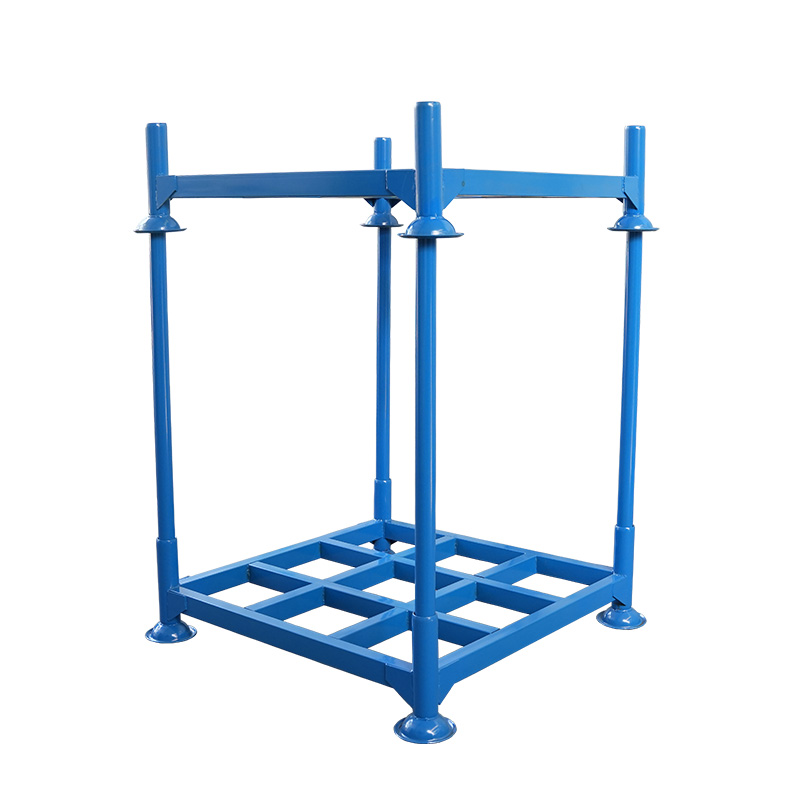
The Insert-Tube Stacking Rack—also known as a detachable stacking rack or post-style stacking rack—consists of a base chassis combined with four removable upright posts. The entire unit is welded from high-quality steel, ensuring a robust and stable structure.
It features flexible assembly and disassembly capabilities, allowing for stacked storage when in use and compact breakdown for storage when idle—thereby occupying minimal floor space. As a mobile storage solution, it is ideal for warehouse turnover, cargo stacking, and bulk storage applications, finding widespread use across industries such as manufacturing, warehousing, cold chain logistics, apparel, and food processing.

Allows for multi-tier stacking, fully utilizing vertical space to achieve three-dimensional cargo storage and significantly improve warehouse space utilization efficiency.
The upright posts can be quickly attached or detached at any time; when not in use, the unit can be disassembled and laid flat for storage, saving substantial space and facilitating easy handling and transport.
The base is designed to be compatible with forklifts and pallet jacks, allowing the entire unit to be easily moved—making it ideal for the cyclical turnover of goods within workshops and warehouses.
Provides independent storage units that allow for the compartmentalized placement of goods, ensuring a neat and orderly arrangement that simplifies inventory management and stocktaking.
Constructed with a fully welded steel structure, it offers high strength and resistance to compression; it remains free of deformation even under heavy loads, making it suitable for storing materials in boxes, bags, or drums.
Available in a variety of specifications, it can be customized with side panels, wire mesh enclosures, or tarpaulin covers to meet diverse storage requirements—ranging from loose bulk goods to full cartons and specialized materials.

The insert-tube uprights can be quickly detached and separated; when idle, the unit can be broken down and laid flat for stacking, occupying a minimal footprint and substantially reducing the costs associated with storing idle equipment.
The structural design allows for multi-tier stacking, enabling the vertical utilization of overhead space. By serving as an alternative to traditional floor-level stacking, it significantly boosts overall warehouse storage efficiency.
Featuring a "Chuan-style" (three-runner) or "Tian-style" (grid-style) base design, the unit is compatible with both forklifts and manual hydraulic pallet jacks, allowing for effortless overall transport and ensuring highly efficient material circulation within workshops and warehouses.
Constructed from fully welded steel, the unit features a robust frame that is highly resistant to impact and compression. It withstands heavy loads without easily deforming, ensuring a long service life.
Available in a comprehensive range of styles and specifications, the unit is suitable for diverse industries—including food, apparel, automotive parts, hardware, and cold chain logistics—offering a low initial investment combined with exceptional practical utility.
Additional accessories—such as mesh enclosures, side panels, canvas covers, and internal dividers—can be easily installed to accommodate the storage of various materials, ranging from full cartons and loose goods to textiles and raw materials.
Stacking rack is a type of shelf, and it is also a unit type movable shelf. Stacking rack is an enlargement of stackable column tray, suitable for storing large and small weight items. At the same time, smart racks can be stacked with each other, both for carrying and empty stacking. Its storage does not depend on the shelf, and is suitable for stacking and turnover of finished products with large storage quantity, single overall dimension, large volume, and light weight.
1. Unified specifications, fixed capacity, clear storage of goods, and easy inventory in the warehouse.
2. It can be stacked high against each other to achieve three-dimensional storage, which can easily form the ability of three-dimensional storage without the need for equipment such as shelves.
3. Suitable for use in areas that are not suitable for investment shelves, such as rental warehouses, low, old-fashioned warehouses, or temporary storage areas in workshops.
4. It can be used in various logistics links such as transportation, handling, loading and unloading, storage and safekeeping, in conjunction with equipment such as forklifts and ground cows.
5. It is welded with strong rectangular tubes, making the structure more robust.
6. When not storing items, they can be inserted into each other for storage, which is easy to operate, widely used, long life, and does not occupy space.
7. Place as needed and move at any time; Realize multi-layer stacking of goods, making full use of space;
8. Various forms, equipped with various accessories, can meet a variety of use needs.
The uprights utilize a tube-insert interlocking design that requires no screws or welding; assembly and disassembly are rapid, allowing a single person to operate the process with ease.
Each stacking rack functions as an independent unit, allowing for flexible combination and the ability to freely increase or decrease the total quantity to suit changing needs and layout adjustments.
Treated with electrostatic powder coating or galvanization, the surface is scratch-resistant, wear-resistant, moisture-proof, and rust-proof, making it suitable for use in indoor, outdoor, and cold storage environments.
Precise alignment features ensure a secure fit when stacking units vertically; the interlocking design prevents slippage or tipping, ensuring a high level of operational safety.
Featuring a simple, lightweight structural design, the unit is exceptionally convenient to handle, transport, and reposition over short distances—even after disassembly.

Constructed from high-quality cold-rolled steel profiles and square tubing, the unit features full, robust welds that ensure high overall structural strength.
Utilizing a split-component, tube-insert structure, the base chassis is reinforced with stiffeners to ensure uniform load distribution, thereby preventing twisting and structural deformation.
Standardized alignment slots are integrated into both the upper and lower sections, ensuring precise positioning during multi-layer stacking and guaranteeing exceptional stability.
Undergoes a surface treatment process involving acid pickling and phosphating, followed by either electrostatic powder coating or hot-dip galvanization, providing superior resistance to oxidation, corrosion, and physical impact.
Features a non-slip base design compatible with various material handling equipment, ensuring smooth and efficient loading and unloading operations.
Dimensions, height, load capacity, and color can all be customized according to specific requirements to meet non-standard warehousing needs.
1. Main Frame: High-quality, thickened cold-rolled square and rectangular steel tubing; offers high strength and excellent toughness.
2. Base Chassis: Thickened structural steel reinforced with welded ribs; provides strong load-bearing capacity and resistance to twisting/deformation.
3. Insert-Tube Posts: High-strength round or square tubing; ensures smooth insertion/connection and high resistance to deformation.
4. Connectors: Integrally stamped and formed components; ensures precise interlocking fit, wear resistance, and durability.
5. Surface Treatment: Electrostatic powder coating / Electro-galvanizing / Hot-dip galvanizing; provides rust prevention, corrosion resistance, and impact protection.
6. Welding Process: Full-weld reinforcement; ensures strong weld points and overall structural stability.
Standard range of 500 kg – 1500 kg; heavy-duty models available via customization.
Typically stackable up to 3–4 layers; features a stable structure that prevents tipping.
Available in multiple standard specifications; supports non-standard customization of length, width, and height.
Detachable insert-tube design; allows for rapid assembly and disassembly without the need for tools.
"Chuan-style" (Three-Runner) or "Tian-style" (Grid) base options; compatible with pallet jacks and forklifts for handling.
Can be upgraded with mesh enclosures, solid panels, canvas covers, or dividers for enhanced functionality.
Suitable for general ambient temperatures; galvanized models are suitable for cold storage and humid environments.
Modular and detachable design; allows for flat-pack storage when idle, occupying minimal floor space.
Categorized storage of raw materials, semi-finished goods, and finished products; facilitates material turnover at workstations and temporary material staging; enables flexible internal logistics.
Suitable for use in freezers and cold storage facilities; ideal for storing rice, flour products, beverages, snack foods, and cold-chain goods, offering excellent moisture resistance and corrosion resistance.
Designed for the bulk storage of fabrics, clothing, and finished home textile products; optional mesh enclosures can be added to prevent items from scattering, and the stackable design helps save space.
Enables the centralized stacking of automotive components, hardware tools, machinery parts, and standard fasteners, ensuring an organized layout that simplifies inventory management.
Facilitates the turnover and temporary storage of parcels, boxed goods, and packaging materials, allowing for convenient loading, unloading, and handling operations.
Supports the multi-tier stacking and storage of personal care products, plastic goods, packaging materials, and finished light industrial products.
Designed for stacking heavy items such as fertilizers, animal feed, and bagged raw materials; features high load-bearing capacity while offering moisture resistance and ventilation.
Offers flexible storage solutions for goods during peak and off-peak seasons; units can be disassembled and stored away when idle, minimizing floor space occupancy.
Allows for the categorized stacking of supermarket inventory and replenishment supplies, ensuring convenient access and simplified management.
1. Place the base of the stacking rack firmly on a level surface.
2. Insert the four upright posts into their respective sockets on the base; ensure they are aligned vertically, pushed all the way down until seated securely, and firmly installed.
3. If mesh enclosures or side panels are required, install and secure them at this stage to prevent goods from scattering.
1. Place goods evenly and centrally on the rack to ensure uniform load distribution; strictly avoid placing loads off-center (unbalanced loading) or exceeding the rack's weight capacity.
2. Stack bagged, boxed, or drummed goods neatly and to a reasonable height; avoid stacking too high, which could cause the load to become unstable or tilt.
1. Align the upper stacking rack with the corner positioning guides on the rack below it; slowly and steadily lower the upper rack into place, ensuring it aligns correctly and settles securely.
2. Typically, units can be stacked 3–4 layers high; however, stacking beyond this height is strictly prohibited to prevent tilting or collapse.
3. Once stacking is complete, inspect the unit from all sides to ensure it is aligned and stable.
1. The base features a "Chuan" (川) or "Tian" (田) shaped structure, making it compatible with both manual pallet jacks and forklifts.
2. During transport, maintain a slow, steady speed; avoid sudden pushing, pulling, or sharp turns to prevent the cargo from tipping over.
1. Empty all cargo from the rack, then disassemble the stacked layers one by one.
The base sockets are precision-engineered to fit the tubes snugly; once inserted, they form a tight, interlocking bond. Under normal stacking and handling conditions, they will not detach; provided the base is placed on a level surface, the structure remains stable.
The standard model typically allows for stacking 3–4 layers high. This depends on the load capacity and the weight of the cargo: fewer layers are recommended for heavy loads, while lighter loads can be stacked to the standard maximum height.
The unit features a fully welded square-tube frame reinforced with bottom stiffeners. The standard load capacity per individual rack ranges from 500 kg to 1,500 kg. Provided the unit is not overloaded or subjected to unbalanced loads, deformation is highly unlikely.
Thanks to its pure insert-tube design, no screws or tools are required. The uprights can be simply inserted into or pulled out of the base sockets, allowing a single person to quickly assemble or disassemble the unit.
The uprights can be detached and laid flat separately, while the bases can be stacked on top of one another for storage. This reduces the storage volume by over 70%, making it an ideal solution for off-season storage.
Yes. Optional accessories—including four-sided mesh enclosures, partition panels, and dust-proof tarps—are available to prevent loose cargo from falling out, making the racks suitable for storing bulk materials.
Yes. The base features a "Chuan" (川) or "Tian" (田) shaped structure that is universally compatible with both manual hydraulic pallet jacks and forklifts, ensuring convenient handling and turnover operations.
The powder-coated models offer standard rust protection; however, for long-term cold storage or highly humid environments, we recommend opting for the galvanized models, which provide superior corrosion and rust resistance.
1. Center and distribute goods evenly on the rack; strictly avoid placing loads off-center or concentrating heavy weight in a single area to extend the service life of the rack structure.
2. When stacking, ensure vertical alignment between the upper and lower units; lower them gently and securely into place to prevent misalignment that could lead to tipping.
3. Operate handling equipment at low speeds when moving the racks; strictly avoid sudden braking, sharp turns, or rough dragging to prevent structural damage.
4. Strictly prohibit overloading the racks, as well as standing on, climbing, or stepping on the stacking units, to ensure operational safety.
5. Periodically inspect the connecting tubes, sockets, and frame joints; if any deformation or rust is detected, perform maintenance or replacement immediately.
6. When not in use for extended periods, disassemble the racks for storage; keep them in a dry environment to minimize oxidation and rust formation.
