
 Products


| Quantity: | |
|---|---|


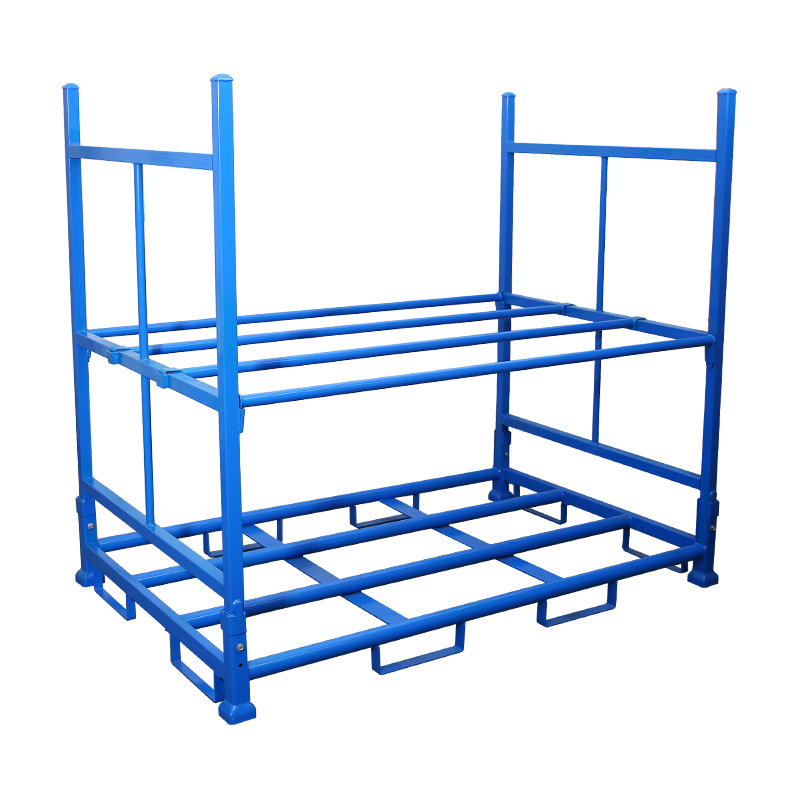
Tire racks are specialized industrial storage racks designed specifically for various tire-related goods—including automotive tires, wheel hubs, and spare tires. The main body is constructed from thickened Q235 cold-rolled steel tubing and plates, welded into a robust form that offers exceptional structural stability and load-bearing capacity. Available in various styles—such as vertical multi-tier, foldable, mobile, and cantilever configurations—the racks feature surfaces treated with anti-corrosion and rust-proofing processes (such as electrostatic powder coating or galvanization). Requiring no complex assembly, they are ready for immediate use upon placement. These racks are ideally suited for environments such as tire manufacturing plants, 4S dealerships, auto repair shops, auto parts warehouses, and logistics transit centers, serving as dedicated storage equipment for the professional organization, classification, and efficient turnover of tire inventory.
Tire rack, also known as tire stacking rack, tire turnover storage rack, or tire storage rack, refers to non-standard customized shelves with strong bearing capacity, safety and stability, flexible application, convenient operation, time and labor saving, and cost reduction. New storage options facilitate warehouse cargo management, classification management, and overall planning of warehouses and workshops.
1. Foot cup and stacking cover: It supports the entire oil tank turnover rack, making its unit or multiple stacking more stable and playing a strong role;
2. Design two or three side guardrails: When storing tires, prevent them from falling off and protect them.
3. Multi forklift cover: The bottom is designed as a multi forklift cover, which can be equipped with multiple forklifts, which is convenient to operate, saves manpower and material resources, and effectively reduces logistics costs;
4. Increase the bearing capacity of the turnover rack, and the bottom can play a certain protective role when carrying tires;
5. The bottom can be equipped with a rear tractor: it can enable vehicle parts turnover vehicles to obtain traction under various driving conditions, connecting the turnover rack with the turnover rack, making it easy to store and turnover;
6. The bottom can be equipped with casters: convenient and fast manual operation, time-saving and labor-saving, multi-functional use, highlighting the mobility and flexibility of the turnover rack;
7. The surface color is optional;
8. Non standard customization: one-on-one design, production, production, professional design, convenient operation, time saving, labor saving, cost reduction, efficiency, and high quality.
Tires can be arranged in distinct tiers and zones based on specifications, models, and dimensions, enabling the categorized storage of new tires, spare tires, and used/scrap tires. This eliminates chaotic stacking and facilitates rapid, systematic inventory management.
Featuring a vertical multi-tier design, the racks fully leverage a warehouse's vertical space. This significantly reduces floor footprint, boosts overall storage space utilization efficiency, and effectively resolves the issue of tires consuming excessive floor area.
The elevated storage design prevents direct contact between the tires and the floor, thereby guarding against moisture damage, deformation, premature aging, and contamination. This effectively protects both the tire treads and sidewalls, extending the overall storage lifespan of the tires.
The open-shelf structure provides clear visibility of all stored tires at a glance. This facilitates rapid searching, retrieval, and inventory counting, eliminating the time-consuming process of rummaging through piles and significantly enhancing the efficiency of warehousing operations.
Capable of stably supporting a wide range of automotive and heavy-duty tires, the racks distribute weight evenly across multiple tiers. They are highly resistant to deformation or tipping, ensuring the safety and security of the stored tires, making them ideal for large-scale tire warehousing operations.
Certain models are equipped with casters (wheels) to allow for mobility, enabling flexible adjustments to storage layouts. These mobile units are suitable for dynamic turnover scenarios across various settings—including workshops, warehouses, and retail stores—and can be relocated without the need for disassembly.
Enables uniform and orderly storage, facilitating the standardized management of tire inventory and significantly enhancing the level of storage standardization in auto repair shops, auto parts stores, and warehouses.

Specifically designed to accommodate the curved contours of tires, ensuring a snug fit for the storage of various passenger car tires, truck tires, spare tires, and wheel rims. It ensures stable placement—preventing rolling—and effectively resolves the issue of haphazard tire stacking.
Features a vertical, multi-tier design that maximizes the use of vertical warehouse space, significantly reducing floor footprint. Compared to flat-layout storage, this system increases storage capacity several-fold.
The elevated storage design keeps tires off the ground—away from moisture, dust, and standing water—preventing deformation caused by compression, as well as aging and cracking. This effectively extends the storage lifespan of the tires.
Constructed with an integral steel frame structure that distributes weight evenly. It is capable of supporting heavy-duty truck tires and large volumes of inventory without deforming or tipping over during long-term use, ensuring maximum storage safety.
Features an open, transparent design that allows tire specifications and quantities to be identified at a glance. This enables rapid retrieval and inventory counting without the need for rummaging, thereby significantly boosting warehouse operational efficiency.
Crafted from thickened steel treated with anti-corrosion processes, the racks are highly resistant to impact, abrasion, and rust. Designed for long-term, cyclical use without the need for frequent replacement, they help reduce overall warehouse investment costs.
Available in various models equipped with universal swivel casters, allowing for effortless pushing, pulling, and transport. This adaptability makes them suitable for easy relocation across diverse environments—including warehouses, workshops, 4S dealerships, and auto repair shops—enhancing operational convenience.
Features a multi-tier cantilever or shelf-based structure that allows tires to be organized by size and model. This ensures clear categorization, facilitates efficient inventory management, and completely eliminates the clutter associated with mixed storage.
Selected models feature a foldable or dismountable design; when not in use, they can be folded down for storage to further conserve space, making transportation and warehousing significantly more convenient.
The shelf decks and cantilever arms undergo anti-slip surface treatment and are fitted with raised edge guards to prevent tires from sliding off, thereby enhancing storage safety.
Available in a wide variety of styles—including fixed, mobile, cantilever, multi-tier vertical, and integrated wheel-and-tire racks—to meet the specific tire storage requirements of diverse operational environments.
Most models are shipped as fully finished units, eliminating the need for complex assembly; simply unpack the product to begin using it immediately, bypassing time-consuming installation procedures.
Customization options—including the number of tiers, dimensions, and load capacity—are available based on warehouse floor area, tire dimensions, and storage volume, ensuring a perfect fit for unique warehousing requirements.

The main structure is fabricated from high-strength Q235 cold-rolled steel tubing and plates. This material is exceptionally rigid, highly resistant to bending and compression, and offers superior load-bearing performance, ensuring long-term durability without deformation.
Utilizing a fully automated, continuous-weld process, the seams are uniform and robust, free from weak or incomplete welds. The overall structure features seamless joints, guaranteeing the rack's stability and load-bearing integrity.
Treated via electrostatic powder coating or hot-dip galvanization, the surface features a coating with strong adhesion. This provides excellent resistance against rust, corrosion, and scratches, making the racks ideal for use in challenging environments such as damp warehouses and auto repair workshops.
The base is widened and reinforced, while the upright columns are thickened to ensure uniform load distribution, preventing tipping even under multi-tier loads. Additionally, the angle of the cantilever arms and shelf decks is contoured to match the curvature of the tires, ensuring a more stable and secure placement.
All corners and edges are rounded and polished to eliminate sharp burrs, preventing accidental scratches or injuries to personnel. Models equipped with universal casters feature integrated braking mechanisms, allowing the rack to be securely locked in place after positioning to prevent accidental sliding.
Featuring uniform dimensions and a rational design, the units can be stacked in bulk and arranged in various configurations. This adaptability makes them suitable for diverse storage environments and facilitates large-scale warehouse management. Tire Rack Technical Specifications and Materials List
| Material Selection | Q235 Cold-Rolled Steel |
| Spot goods | 1200*1500*1250 |
| Uprights | 50*50/1.2/1.5/2.0/2.5 |
| Base Frame | 50*50*1.2/1.5/2.0 |
| Guardrails | 30*40*1.0/1.2/1.5 |
| Reinforcement Ribs | 30*50*1.0/1.2/1.5 |
| Powder Coating | |
| Color Samples | blue |
| Load-bearing Capacity | 500 kg – 5 tons |
| Load-bearing capacity | 1 ton |
| Non-standard customization is available based on client requirements. | |
Main Body Material:Q235 Thickened Cold-Rolled Steel Tubing, Cold-Rolled Steel Plate
Tubing Specifications: Uprights: 40×40mm / 50×50mm Square Tubing; Beams/Cantilevers: 30×30mm / 40×40mm Square Tubing
Plate/Tubing Thickness:1.2mm, 1.5mm, 2.0mm, 2.5mm (3.0mm available for heavy-duty models)
Standard Dimensions (L×W×H) :- Small Passenger Car Tire Rack: 1200×600×1500mm, 1500×700×1500mm; - Medium Truck Tire Rack: 1800×800×2000mm, 2000×900×2000mm; - Non-standard/Custom sizes available
Tier Design: 2-Tier, 3-Tier, 4-Tier, 5-Tier (Customizable)
Load Capacity Per Tier: 100kg, 200kg, 300kg, 500kg
Overall Rated Load Capacity: 300kg, 600kg, 1000kg, 1500kg
Product Structure: Fixed, Foldable, Cantilever, Mobile (with Casters)
Surface Treatment Process: Electrostatic Powder Coating, Hot-Dip Galvanizing, Baked Enamel Paint (Rust and Corrosion Resistant)
Welding Process: Fully Automatic Continuous Welding; Welds are firm, free of cold welds, and burr-free
Anti-Slip & Safety Features: Anti-slip treatment on shelves/cantilevers; Raised edge guards/lips
Mobility Configuration: Swivel Casters (with Brakes): 4-inch, 5-inch (Optional)
Applicable Tire Types: Passenger Car Tires, SUV Tires, Truck Tires, Spare Tires, Wheel Rims
Stacking/Storage: Fixed models are non-foldable; Foldable models can be collapsed when unloaded
Product Net Weight: 30kg – 80kg (Varies based on dimensions and material thickness)
Applicable Scenarios: Tire Factories, 4S Dealerships, Auto Repair Shops, Auto Parts Warehouses, Logistics Transit Centers
Organize and store new tires, replacement tires, and spare tires with clear categorization, facilitating after-sales replacement services and inventory management.
Centralize the storage of replacement tires, snow tires, and all-season tires to prevent cluttered stacking and wasted floor space, ensuring quick and easy access.
Stack large volumes of tires and wheel hubs in multi-tiered configurations to maximize storage capacity and streamline bulk sorting and shipping operations.
Facilitate the in-workshop circulation and temporary storage of finished and semi-finished tires; provides protection against dust and moisture while standardizing material organization along the production line.
Support the bulk transit, temporary storage, and sorting of tires; designed for use with forklifts to boost loading, unloading, and turnover efficiency.
Provide centralized storage for spare tires used by public buses, logistics fleets, and heavy-duty engineering vehicles, simplifying routine replacement and maintenance tasks.
Categorize and store spare tires from complete vehicles alongside aftermarket wheels and tires, creating a neat and aesthetically pleasing display that facilitates sales and inventory management.
Serve a dual purpose for both retail display and storage; ensures a tidy arrangement that conserves floor space and enhances the store's overall image.
Place the tire rack on a level, firm, and dry surface.
For models equipped with casters, move the rack to the designated location and then engage the wheel brakes to lock it in place and prevent sliding.
Store tires in categorized layers based on model and size; position tires vertically so they rest securely within the rack's cantilever arms or shelf levels.
Handle tires gently when placing them; ensure they are arranged neatly with weight distributed evenly to avoid lopsided loads or stacking beyond the rack's height limits.
Strictly adhere to the rated load capacity for each individual shelf layer; do not exceed the weight limit per layer or stack items beyond the designated number of layers.
Place heavier tires on the lower shelves and lighter tires on the upper shelves to maintain a stable overall center of gravity and prevent the rack from tipping over.
Handle tires with care during storage and retrieval; strictly avoid forceful dragging or striking the rack.
When retrieving tires from upper levels, take precautions to avoid colliding with items on lower levels or the rack structure itself.
When moving a wheeled tire rack, first empty the rack or reduce its load, then push it slowly and carefully.
Strictly avoid rapid pushing or pulling while fully loaded, and do not move the rack up or down steep inclines, to prevent tipping or structural deformation.
When storing a foldable rack, first remove all tires, release the locking latches, and fold the unit down in accordance with proper procedures.
When setting up for use, fully extend the rack and securely fasten the locking latches; verify that the structure is stable before loading any goods.
Periodically inspect weld points, the main frame, and retaining edges for any signs of deformation or looseness.
Keep the rack structure dry; promptly clean off any accumulated dust or grease. Touch up any chipped paint areas to prevent rust.
- Causes: Lack of retaining edges/barriers; tilted placement of tires; uneven flooring beneath the rack; unstable positioning of tires.
- Recommendations: Select a rack model equipped with retaining edges or anti-slip features; ensure the rack is placed on level, even ground; position tires vertically and snugly against each other, avoiding tilted or haphazard placement.
- Causes: Thin-walled upright columns; weak or faulty welds; uneven or bumpy flooring; uneven weight distribution (load shifted to one side).
- Recommendations: Place the rack on a hard, level surface; place heavier items on the lower levels and distribute the load evenly across the rack; periodically inspect welds and the frame structure, and reinforce any loose components immediately.
- Causes: Severe overloading (exceeding weight limits); excessive weight concentrated on a single shelf/level; prolonged, uneven stress on one side of the rack.
- Recommendations: Strictly adhere to the rack's rated load capacity; distribute tires of different sizes and weights across different levels in a balanced manner; for heavy-duty applications, select a reinforced rack model constructed with thicker tubing.
- Causes: High humidity in the workshop environment; outdoor storage/exposure to the elements; corrosion caused by grease, mud, or water; damage to the protective paint finish.
- Recommendation: For humid environments, prioritize the galvanized model; avoid prolonged exposure to rain outdoors; promptly clean off oil stains, and touch up any chipped paint to prevent rust.
- Causes: Debris entangled in wheels, rusted bearings, or worn/aged brake components.
- Recommendation: Regularly clear debris from the wheels; periodically maintain and lubricate the wheel axles; promptly replace caster components if the brakes are damaged.
- Causes: Dust accumulation or rust at hinge points, deformed latches, or misaligned limiters.
- Recommendation: Empty the contents before folding or unfolding the unit; periodically clean and apply a small amount of lubricant to the hinges; straighten any deformed latches and ensure they lock securely into place.
- Causes: Burrs or sharp edges on the rack frame, improper spacing between racks, or rough handling during loading/unloading.
- Recommendation: Choose models with smooth, deburred edges; maintain appropriate spacing between racks; handle tires gently to avoid forceful rubbing or scraping against the rack.
- Causes: Lack of categorization, mixing tires of different specifications, or inefficient use of vertical space (shelving layers).
- Recommendation: Store tires in designated zones or layers based on size, vehicle model, or season (e.g., summer vs. winter tires); use labels for categorized management to maximize storage capacity and improve inventory efficiency.
