
 Products


| Quantity: | |
|---|---|


Steel pallets for automated warehouses are specialized load-bearing platforms designed specifically for automated high-bay storage systems. Crafted from high-quality Q235 steel, these pallets feature a robust structure and high dimensional precision. Engineered to integrate seamlessly with stacker cranes, shuttle carts, and intelligent racking systems, they offer exceptional load-bearing capacity without deformation. Perfectly suited for intelligent warehousing automation operations, they serve as the dedicated load-bearing medium for high-density vertical storage environments.
Fully compatible with automated warehouse stacker cranes and shuttle carts, enabling automated cargo transfer, storage, and retrieval.
Provides stable load support on high-bay racking systems, meeting the requirements for storing heavy-duty cargo at elevated heights.
Features precise dimensions and high surface flatness, ensuring the smooth and jam-free operation of intelligent handling equipment.
Facilitates the unitization of cargo loads, thereby enhancing storage density and space utilization within the automated warehouse.
Isolates and protects cargo from moisture and physical impact, ensuring the integrity and pristine condition of stored goods.
Robust and long-lasting, capable of withstanding high-frequency automated circulation and suitable for continuous, long-term reuse.
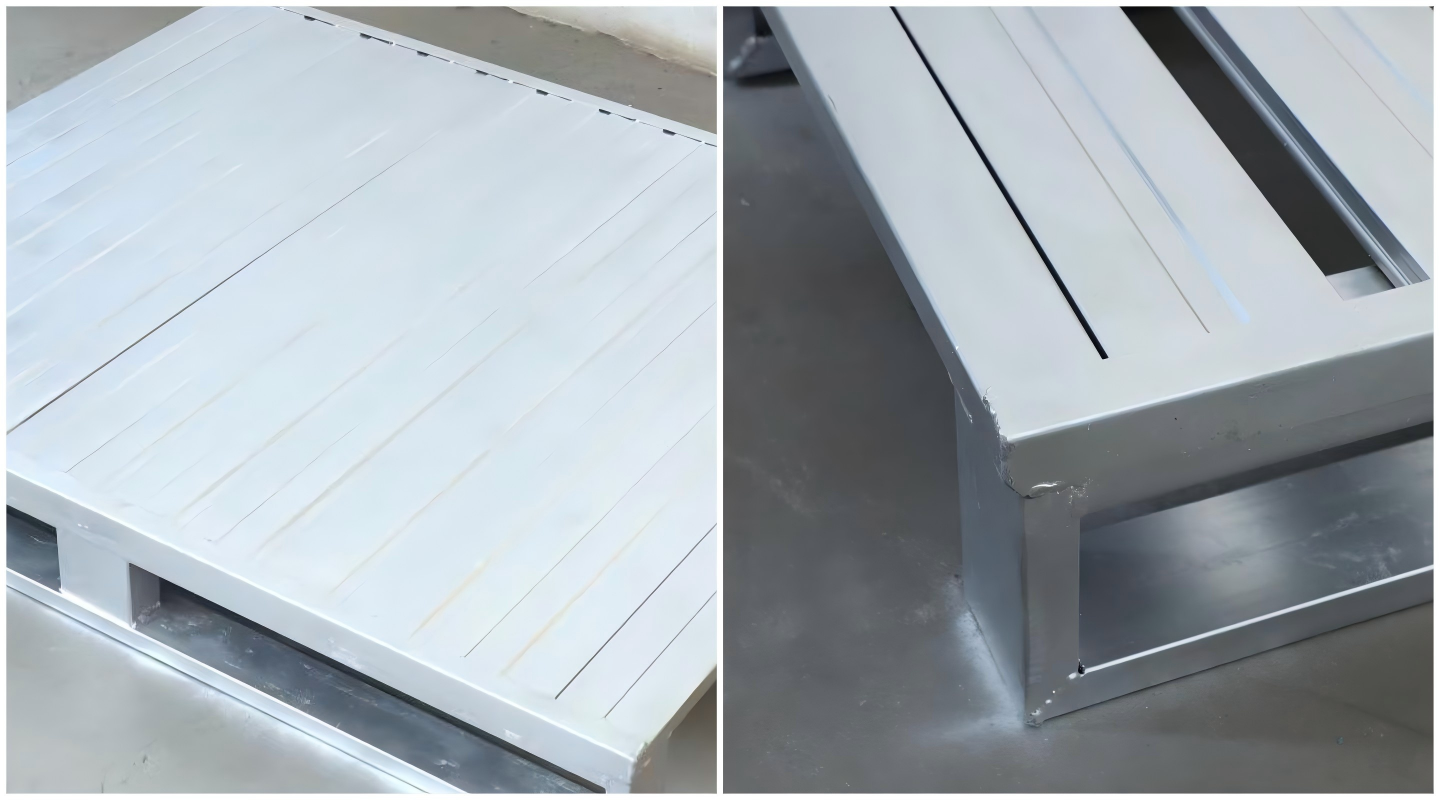
Designed specifically for automated high-bay warehouses, these pallets integrate perfectly with intelligent equipment—such as stacker cranes, shuttle carts, and AGVs—to enable unmanned, automated storage and transfer operations, thereby significantly boosting warehousing efficiency.
Constructed with a fully reinforced steel structure, the pallets resist bending or sagging even under heavy loads. They demonstrate superior performance across dynamic loads, static loads, and rack-supported loads, effectively meeting the long-term storage requirements for heavy cargo in high-rise automated warehouses.
Manufactured in strict accordance with automated warehouse racking standards, these pallets exhibit minimal dimensional deviation and exceptional overall flatness. This precision prevents equipment jamming and cargo misalignment, thereby ensuring the uninterrupted continuity of automated operations.
Crafted from robust, wear-resistant, and impact-resistant materials that are also resistant to acids and alkalis, these pallets are built to withstand high-frequency automated circulation. Unlike plastic or wooden pallets, they are highly durable, rarely require replacement, and offer a significantly longer service life, resulting in reduced long-term maintenance and operational costs.
Designed to integrate with automated high-bay storage systems, enabling high-level, high-density cargo storage. By fully utilizing vertical space, it boosts space utilization efficiency several-fold compared to conventional warehousing, thereby reducing the required warehouse footprint.
Features a robust overall structure with zero risk of cracking or cargo spillage. It is fire-resistant, moisture-proof, and mold-resistant, making it suitable for a wide range of demanding storage environments while ensuring the dual safety of both the cargo and the operating equipment.
Adheres to unified, standardized specifications, facilitating easy cargo scanning, location tracking, and inventory counting. It integrates seamlessly with Warehouse Management Systems (WMS) to enable intelligent, digitized inventory control.
Unlike standard steel pallets, this product features a structure optimized specifically to meet the operational requirements of stacker cranes (for gripping) and shuttle carts, making it perfectly suited for the unique working conditions of high-bay racking and automated storage systems.
The pallet surface is flat and smooth—free from protrusions or deformation—ensuring stable cargo placement and precise gripping by equipment, thereby eliminating potential storage and retrieval failures.
The structure is optimized to achieve a more efficient tare weight while maintaining exceptional load-bearing capacity. This reduces the operational load on handling equipment and lowers energy consumption in automated systems.
Compatible with the fork-entry operations of various intelligent handling devices. With no directional restrictions, it enhances the flexibility of automated cargo transfer and movement.
The surface undergoes electrostatic powder coating or hot-dip galvanization treatments, providing superior rust and corrosion resistance as well as wear resistance. It requires no complex daily maintenance and is built to withstand long-term, high-frequency usage.
Dimensions, structural configurations, and load-bearing specifications can be fully customized based on the specific dimensions of the high-bay racking, load requirements, and cargo specifications, ensuring a perfect fit for unique warehousing needs.
Steel pallets, also known as steel pallets, iron pallets, and metal pallets, are one of the important storage and transportation auxiliary equipment in modern industry. The main material is galvanized steel plate and steel, which are formed by special equipment, supported by various profiles, connected and strengthened by rivets, and then welded under C02 gas protection. Used for ground storage, shelf storage, cargo intermodal transportation, turnover and other ultra-light metal tray series.
1. The carrying capacity is the strongest in pallets.
2. Steel pallets are 100% environmentally friendly and can be recycled without wasting resources.
3. The surface of the steel tray shall be treated with a smooth surface and the periphery shall be wrapped. The tray chassis is solid, light in weight and strong in rigidity, with stable packaging performance;
4. Waterproof, moisture-proof and rustproof steel tray; Compared with wooden pallets, it has environmental advantages (such as the capacity of wooden pallets to breed pests); Compared with plastic pallets, it has strength, wear resistance, temperature resistance, and price advantages.
5. Especially when used for export, steel pallets do not require re steaming, high-temperature disinfection, or anti-corrosion treatment in accordance with international environmental regulations
6. Flexible use of steel pallets (4-way insertion design virtually improves the convenience of space utilization and operation, and its sturdy bottom plate design also conforms to the use of assembly lines and automatic packaging systems)
Constructed using high-strength Q235 cold-rolled steel plates and precision square tubing. The materials feature uniform composition and excellent mechanical properties, guaranteeing the overall structural integrity and dimensional stability of the pallet.
Fully automated CNC welding ensures uniform, robust seams free of cold welds. Subsequent professional leveling treatment ensures that dimensional accuracy and flatness meet the rigorous standards required for automated warehousing systems.
Reinforcing ribs and crossbeams are added to the base to scientifically distribute loads, preventing localized deformation under heavy weight and significantly enhancing both the load-bearing capacity and overall stability of the pallet.
High-precision, standardized processes are implemented throughout the entire production cycle. Deviations in external dimensions, height, and fork-entry spacing are controlled within extremely tight tolerances to meet the operational requirements of automated handling equipment.
Utilizing high-temperature electrostatic powder coating and hot-dip galvanizing for corrosion protection, the surface features strong adhesion and exceptional flatness. Highly resistant to abrasion and chipping, the finish is designed to withstand the rigors of long-term, high-cycle usage.
The pallet deck features an added anti-slip texture, while the base incorporates a specialized positioning structure. This design prevents cargo from sliding and pallets from shifting, ensuring the precise and error-free operation of automated handling equipment.
Designed to integrate seamlessly with stacker cranes, shuttle carts, and AGVs, enabling fully automated storage, retrieval, and intelligent scheduling for unmanned warehousing operations.
Specifically engineered for high-bay racking systems—including beam-type, drive-in, and shuttle-based configurations—facilitating high-level, heavy-load storage and maximizing the utilization of vertical warehouse space.
Ideal for mechanical manufacturing, automotive parts, and heavy industry enterprises; enables the standardized, unitized storage and automated circulation of raw materials, semi-finished goods, and finished products within the workshop environment.
Suitable for major logistics hubs and e-commerce fulfillment centers; integrates with automated conveyor lines to facilitate the automatic transport, sorting, inbound processing, and outbound dispatch of goods.
Provides storage solutions for raw materials and finished products within the lithium battery, photovoltaic, and energy storage industries, meeting the stringent requirements for high-precision, ultra-clean, and automated warehousing environments.
Designed for the storage of precision electronic components and finished home appliances; the pallet's exceptional flatness and structural rigidity prevent deformation, thereby protecting delicate cargo and ensuring compatibility with intelligent warehousing systems.
High-level storage for heavy raw materials and industrial supplies; features fire resistance, moisture resistance, and corrosion resistance, making it suitable for heavy-duty loads and complex warehouse environments.
Centralized control and management of equipment components and tooling materials; integrates with intelligent warehousing systems to facilitate digital inventory counts and precise management.
1. Cargo must be placed centrally and evenly, ensuring the center of gravity remains centered; off-center loading (placing the entire load to one side) and concentrated heavy pressure points are strictly prohibited.
2. Cargo must be stacked neatly and uniformly, ensuring it does not extend beyond the edges of the pallet; this prevents scraping against racks or equipment and avoids jamming automated machinery.
3. Heavy-duty cargo must be distributed across the entire surface of the pallet; single-point or localized stacking is prohibited to prevent the pallet from bending or deforming.
1. Pallets must strictly match the specifications of the automated equipment (stacker cranes, shuttle carts, AGVs, conveyor lines); pallets with incompatible dimensions are strictly prohibited from entering the automated system.
2. Pallets must remain flat, free of deformation, broken welds, or warping; damaged pallets are strictly prohibited from entering the automated high-bay warehouse.
3. During automated storage and retrieval operations, manual intervention—such as forceful pushing or pulling—is strictly prohibited to prevent equipment jams or malfunctions.
1. The forks must be fully inserted into the pallet's entry slots and aligned centrally; inserting at an angle, forceful ramming, or violent impact with the pallet is strictly prohibited.
2. Lifting and lowering operations must be performed smoothly and slowly; sudden rapid movements, dragging, or dropping of the pallet are strictly prohibited.
3. When transporting loads, vehicles must proceed at a reduced speed to avoid collisions with racks, support columns, or walls.
1. These pallets are designed exclusively for use with specialized high-bay warehouse racking systems; placing loads exceeding the rack's weight capacity is strictly prohibited.
2. The pallet must be placed fully and securely onto the rack's support beams, ensuring it is properly seated without any overhang or suspended sections.
3. Pallets exhibiting deformation, cracks, or damage to weld points are strictly prohibited from being placed on high-level storage racks.
1. Empty pallets should be stacked neatly and aligned precisely, with a reasonable number of layers to avoid excessive height or haphazard stacking.
2. Idle pallets should be stored flat in a dry area to prevent exposure to rain or standing water, which can lead to rust.
1. Regular Inspection: Periodically check welds, deck panels, bottom beams, and look for deformation, paint chipping, or rust. Any damaged units should be repaired or retired immediately.
2. Prohibitions: Do not use beyond rated load capacity; avoid rough handling; do not perform unauthorized cutting or structural modifications; avoid prolonged immersion in strong acids or alkalis.
3. Promptly clear debris and oil stains from the pallet surface to ensure smooth operation within automated conveying systems.
- Causes: Poor manufacturing precision; deformation resulting from prolonged load-bearing stress; warping or unevenness.
- Recommendations: Select high-precision, custom-manufactured pallets designed specifically for automated storage systems; strictly prohibit deformed pallets from entering the automated system; conduct periodic spot checks on length, width, and flatness, and immediately remove any pallets that exceed tolerance limits.
- Causes: Overloading; uneven cargo distribution (eccentric loading); lack of internal reinforcement ribs; concentrated heavy pressure at a single point.
- Recommendations: Strictly adhere to the racking system's rated load capacity; ensure cargo is distributed evenly across the entire pallet surface with the center of gravity positioned centrally; select pallets featuring reinforced and thickened structural designs specifically engineered for automated storage systems.
- Causes: Forceful gripping by stacker cranes; impact collisions with forklifts; prolonged exposure to high-frequency, repetitive stress; weak or defective welding.
- Recommendations: Ensure smooth and precise docking with automated equipment to eliminate forceful bumping or jarring; conduct regular inspections of weld points; repair cracked areas by re-welding and reinforcing, or immediately scrap pallets with severe structural damage.
- Causes: High warehouse humidity; significant temperature fluctuations; condensation formation; surface scratches on the paint finish.
- Recommendations: Maintain a dry and well-ventilated warehouse environment; sand down and touch up paint on damaged areas; for humid environments, select corrosion-resistant pallet models featuring hot-dip galvanized finishes.
- Causes: Rough handling during insertion; angled insertion or forceful prying; deformation of bottom support feet due to impact.
- Recommendations: Standardize alignment during fork entry; strictly prohibit angled insertion or dragging; repair and straighten deformed support feet; segregate damaged pallets and keep them off automated lines.
- Causes: Smooth pallet surface; uneven stacking; shifted center of gravity.
- Recommendations: Install anti-slip features; stack cargo neatly and ensure it does not overhang the pallet edges; secure heavy cargo via strapping or stretch wrapping.
- Causes: Mixing standard steel pallets with pallets designed for automated storage systems (AS/RS); discrepancies in height or spacing.
- Recommendations: Manage AS/RS-specific pallets separately and standardize their models; store them in designated areas; strictly prohibit mixing different pallet types on automated lines.
- Causes: Stacking empty pallets too high; crooked or uneven stacking.
- Recommendations: Limit the number of stacked layers; ensure pallets are stacked flat and aligned vertically; do not use deformed pallets in high-bay racking systems or automated storage zones.
- Causes: Insufficient grinding/finishing; rough manufacturing workmanship.
- Recommendations: Inspect for proper grinding/finishing prior to warehousing; for automated storage zones, utilize specialized pallets featuring precision grinding and flush-finished weld spots.
