 Products


| Quantity: | |
|---|---|


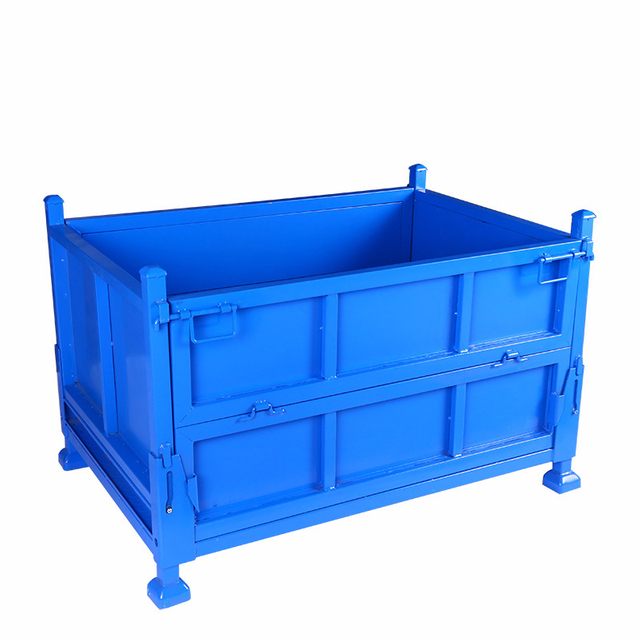
The fixed storage bin is a one-piece, non-collapsible industrial metal container. Primarily constructed from high-quality Q235 cold-rolled steel plate or welded steel wire, it features a robust, unitary structure with no moving parts, offering stable load-bearing capacity and high impact resistance.
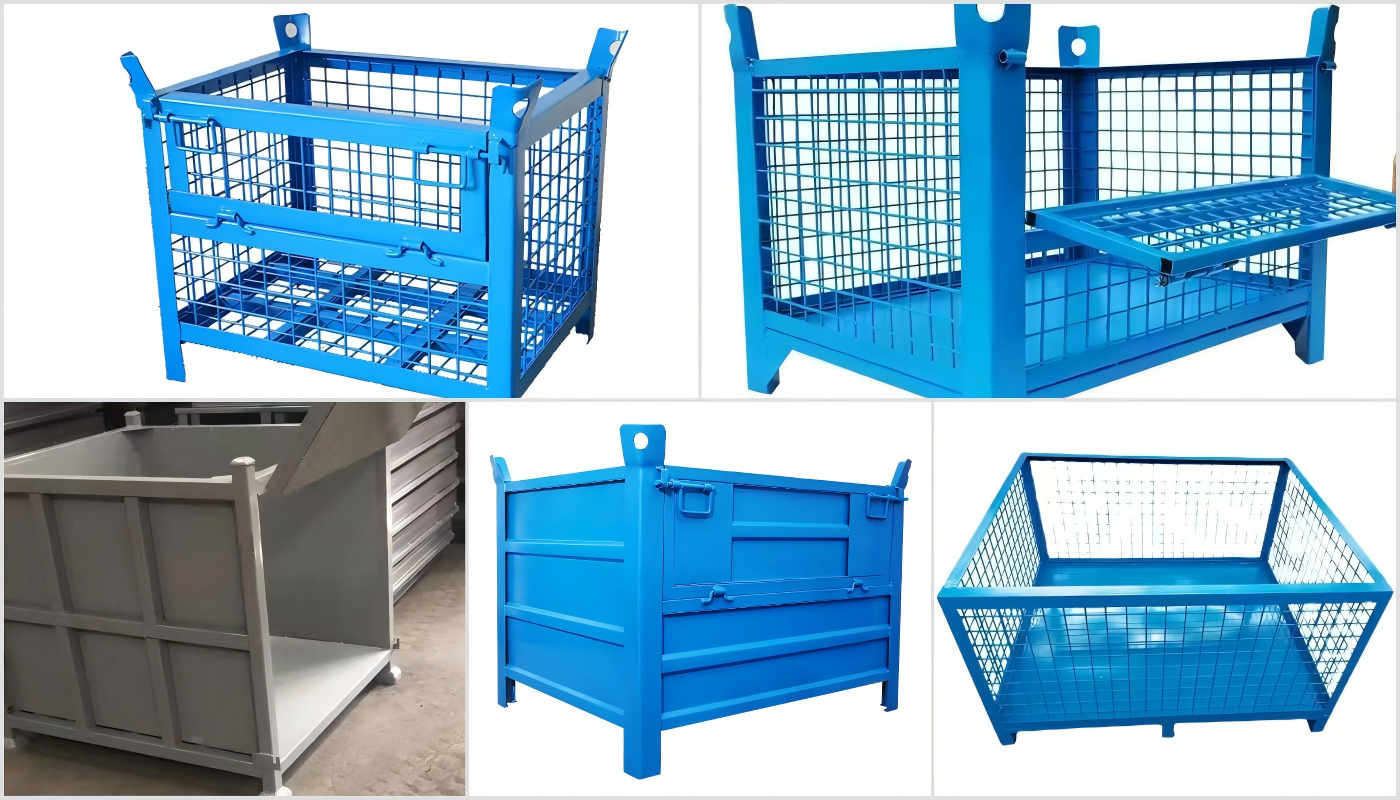
Available in solid-walled (enclosed) and wire-mesh (open) versions, these bins feature a standard forklift-compatible base and an anti-rust, anti-corrosion surface finish. They require no assembly and are ready for immediate use. Designed for the centralized storage and handling of heavy materials, components, and finished goods in factory workshops and warehouses, they are suitable for industrial storage applications across various sectors.
1. Stable Storage
Provides organized, uniform storage for components, semi-finished goods, finished products, bulk materials, and heavy items; prevents cluttered stacking and enables zoned, categorized management.
2. Multi-level Stacking
Supports direct vertical stacking, maximizing warehouse vertical space, significantly increasing storage capacity, and saving floor space.
3. Efficient Handling and Transfer
Features a four-way forklift entry base compatible with forklifts and manual pallet jacks, facilitating rapid material transfer across workshops, warehouses, and logistics hubs.
4. Material Protection
Enclosed or mesh-walled structures effectively prevent material loss, crushing, or impact damage, preserving the appearance and functional integrity of the goods.
5. Long-term Reusability
Features a durable, one-piece fixed structure with no fragile moving parts; built for long-term, repeated use, thereby reducing consumable storage costs.
6. Convenient Inventory Management
Centralized storage simplifies daily stock checks, counting, and sorting, enhancing overall warehouse and workshop management efficiency.
1. Robust Structure with High Load-Bearing Capacity
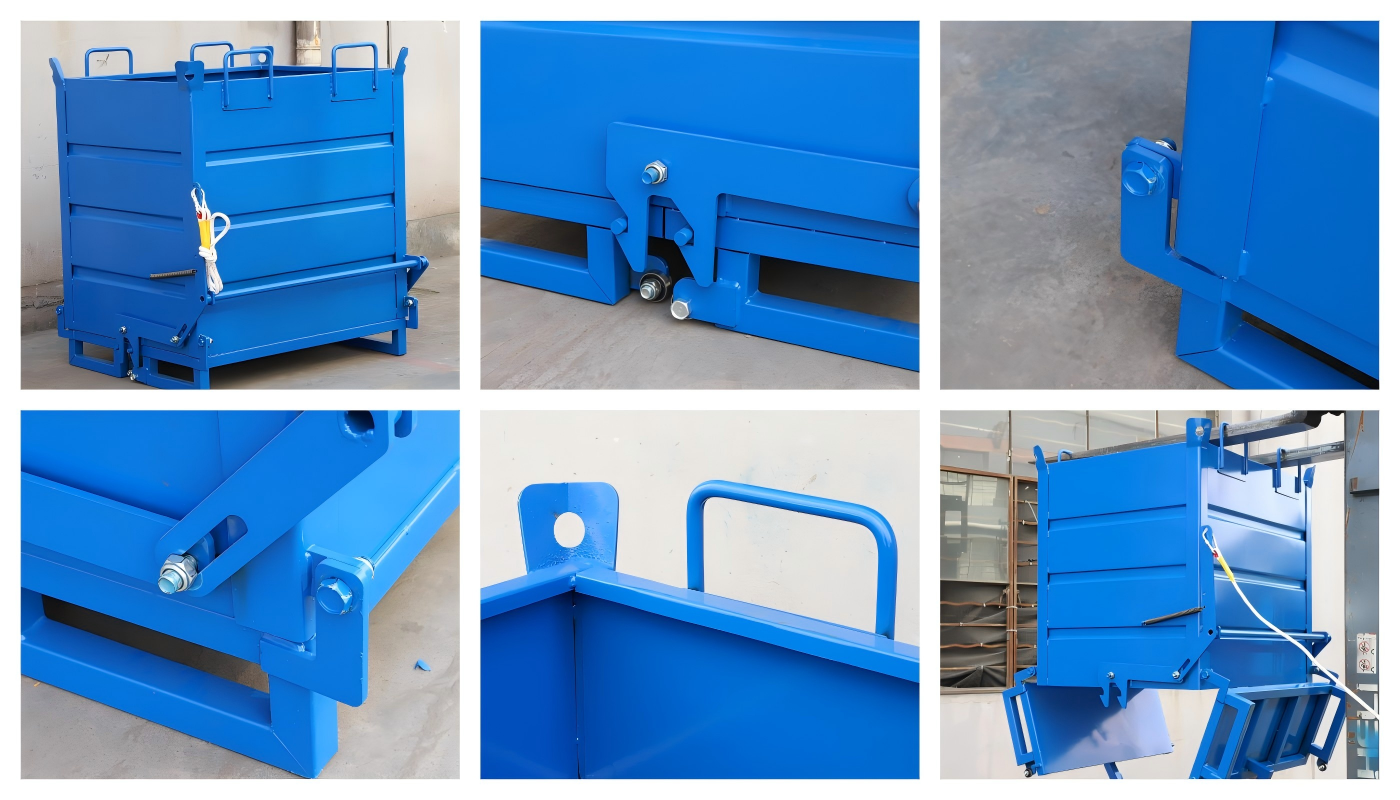
Features a one-piece welded structure with no moving parts; offers superior resistance to compression and impact, safely supporting heavy loads without deforming or cracking over long-term use.
2. Stable Stacking and Space Efficiency
Equipped with precise alignment features for secure, tight vertical stacking; remains stable even when fully loaded, maximizing vertical warehouse space and allowing for neat storage when not in use.
3. Convenient and Efficient Handling
Standard four-way forklift entry allows for easy handling with forklifts and pallet jacks, enabling rapid lifting and transport for seamless circulation across workshops, warehouses, and logistics operations.
4. Comprehensive Material Protection
Available in solid-wall or mesh designs that offer protection against dust, moisture, and crushing; effectively prevents material loss or damage and is suitable for storing a wide range of materials.
5. Durable and Cost-Effective
Constructed from thickened steel with an anti-corrosion finish; highly resistant to wear and impact, suitable for long-term, repeated use, and significantly reduces enterprise costs for packaging and storage consumables.
6. Standardized Management and Easy Inventory
Features uniform specifications for unitized storage and clear categorization/zoning; facilitates daily inventory checks and management, thereby enhancing overall warehouse operational efficiency.
1. Fixed Structure: Durable and Hassle-Free
The non-folding, hinge-free design eliminates common issues found in collapsible models—such as sticking mechanisms or damaged parts—resulting in simple maintenance and a longer service life.
2. Precise Positioning: Safe Stacking
Specially designed slots and protrusions on the top and bottom ensure automatic, precise alignment during stacking; this prevents misalignment or slippage, guaranteeing safety even when stacked high.
3. Diverse Styles: Tailored to Your Needs
Available in various configurations—including solid-wall, ventilated (mesh), door-equipped, and caster-mounted models—allowing for flexible selection based on material requirements (e.g., moisture resistance, ventilation, protection) and specific usage scenarios.
4. User-Friendly Design Details
Rounded corners prevent scratches; designated label areas on select models facilitate cargo identification and sorting; the streamlined structure makes cleaning and maintenance easy.
5. Broad Compatibility and Versatility
Designed with standard dimensions, these units are compatible with various shelving systems and pallets, making them suitable for a wide range of industrial environments, including factories, warehouses, and logistics centers.
1. High-Quality, High-Strength Steel Selection
The main body is constructed from Q235 cold-rolled steel plate or square tubing, offering high strength and excellent toughness; it withstands heavy loads and resists deformation.
2. Precision Welding Process
Utilizes fully automated continuous or spot welding; welds are uniform, full, and secure—free from cold joints or missed welds—ensuring the structural integrity and stability of the unit.
3. Advanced Surface Treatment Technology
Features electrostatic powder coating, baked enamel, or hot-dip galvanizing; the coating is dense and uniform with strong adhesion, providing excellent resistance to rust, corrosion, and wear, making it suitable for harsh environments involving moisture or oil.
4. Engineered Structural Design
Reinforcing ribs or beams are installed at the base and frame to ensure even load distribution; this effectively enhances overall load-bearing capacity and structural stability, preventing localized collapse.
5. Standardized Modular Design
Key specifications—such as dimensions and forklift entry points—are highly standardized to facilitate mass production, procurement, and management, while ensuring compatibility with mainstream warehousing equipment.
Main Material: High-quality Q235 cold-rolled steel plate; reinforced cold-rolled square tube/channel steel frame
Plate Thickness: Side panels 1.0–2.0 mm; base plate 1.5–2.5 mm; reinforcing ribs/frame 2.0–3.0 mm
Mesh Wire Specifications: Wire diameter 4.0–8.0 mm; mesh sizes 50×50 mm, 50×100 mm, 100×100 mm
Standard Dimensions (L×W×H): 800×800×600 mm, 1000×800×800 mm, 1200×1000×800 mm, 1200×1000×900 mm (customizable upon request)
Rated Load Capacity: 500 kg, 800 kg, 1000 kg, 1500 kg, 2000 kg
Stacking Capability: Stable stacking of 2–5 layers when fully loaded
Fork Entry: Standard 4-way bottom entry; compatible with forklifts and manual pallet jacks
Welding Process: Fully automatic continuous welding or reinforced spot welding; strong, secure welds with no cold joints or detachment
Surface Treatment: Electrostatic powder coating, baked enamel, or hot-dip galvanizing (anti-corrosion/rust-proof options available)
Product Structure: Integrated fixed structure; non-collapsible, no moving parts
Product Weight: 40–100 kg (varies based on dimensions and plate thickness)
Suitable Environments: Industrial workshops, ambient-temperature warehouses, cold storage, outdoor storage, logistics transfer areas
Optional Accessories: Access door, label holder, anti-slip base, casters, internal dividers
Product Features: Integrated molding, compression and impact resistance, stable load-bearing, no assembly required, reusable
1. Factory Production Workshops
Centralized storage and circulation of mechanical parts, stamped components, hardware fittings, and semi-finished goods along assembly lines.
2. Corporate Raw Material/Finished Goods Warehouses
Categorized storage and multi-level stacking of various materials; maximizes storage capacity while ensuring neat and organized arrangement.
3. Automotive Parts Manufacturing
Storage and transfer of automotive components, rubber/plastic parts, and small heavy-duty items; features high load-bearing capacity and impact resistance.
4. Hardware and Machinery Industries
Storage of standard parts, tools, castings, and heavy materials; rugged and durable, built for long-term, high-frequency use.
5. Logistics and Transit Warehousing
Centralized cargo handling and short-distance transfer; compatible with pallet jacks and forklifts for efficient material handling.
6. Injection Molding and Rubber/Plastic Plants
Storage of plastic parts, raw materials, and scrap; oil and abrasion-resistant, suitable for demanding workshop environments.
7. Humid or Standard Factory Areas
Available in powder-coated or galvanized finishes; rust and corrosion-resistant, ideal for long-term use in standard warehouses or humid workshops.
8. Heavy Industry and Equipment Manufacturing
Unified storage for heavy workpieces and loose components; one-piece structure prevents deformation, ensuring high storage safety.
1. Placement
Place the container on a flat, solid surface; ensure it sits level and stable, avoiding any overhang or suspension on one side.
2. Loading
Distribute materials evenly; do not overload or create unbalanced loads. Place heavy items in the center rather than stacking them on one side to prevent container deformation.
3. Stacking
Align and securely interlock stacked containers; strictly adhere to stacking limits. Do not stack beyond height or weight capacities to prevent tipping.
4. Handling
When using pallet jacks or forklifts, ensure proper fork entry (from any of the four sides) and fully insert the fork arms into the base; Lift gently and move slowly; avoid forceful pushing, ramming, or dragging the container.
5. Material Retrieval
Handle materials with care to avoid impacts from hard objects against the container; organize the container promptly after retrieving materials to facilitate future stacking.
6. Routine Maintenance
Regularly inspect the container body and frame for weld deformation or cracking;
Keep the container clean and dry; promptly repair damage or paint loss to extend its service life.
1. Issue: Container deformation, bottom panel sagging, frame bending
Cause: Overloading, off-center loading, prolonged heavy pressure, or rough impact.
Recommendation: Strictly adhere to rated load capacities; distribute materials evenly and place heavy items in the center; avoid stacking on one side; use reinforced/thickened models for heavy-duty materials.
2. Issue: Instability, misalignment, or tipping risk during multi-layer stacking
Cause: Uneven flooring, poor vertical alignment, container deformation, or exceeding stacking limits.
Recommendation: Place on flat, solid ground; ensure precise alignment and interlocking when stacking; reduce stacking height for deformed containers; do not exceed maximum stacking height.
3. Issue: Surface rust, paint peeling, or corrosion at weld points
Cause: Humid workshop conditions, heavy oil/grease exposure, damaged paintwork, or prolonged outdoor storage.
Recommendation: Choose galvanized models for humid environments; maintain dry and ventilated conditions; touch up peeled paint promptly; clean off oil and grease regularly.
4. Issue: Difficulty engaging with forklifts/pallet jacks; risk of damaging the container bottom
Cause: Deformed fork entry points, overcrowded placement, rough handling, or incomplete fork insertion.
Recommendation: Leave adequate aisles for handling; fully insert fork arms before lifting or lowering; avoid ramming, dragging, or violently striking the containers.
5. Issue: Sharp edges/corners causing scratches to workpieces or injuries to personnel
Cause: Unfinished edges or residual welding burrs.
Recommendation: Purchase models with rounded, smoothed corners; inspect for burrs regularly and grind them down; ensure safe handling practices.
6. Issue: Small items falling out or scattering
Cause: Large gaps in the container structure or lack of protective barriers.
Recommendation: Use liners, dividers, or protective mesh; consolidate small items to prevent leakage through gaps.
7. Issue: Weld cracking or localized weld failure
Cause: Prolonged rough handling/vibration, heavy impacts, or poor welding quality. Recommendation: Handle with care to minimize impact; inspect welds regularly and promptly repair or reinforce any cracks.
8. Issue: Difficult to clean; accumulation of grease and grime
Explanation: Workshops often have high levels of dust and oil, and structural "dead zones" easily collect dirt.
Recommendation: Regularly clean using high-pressure methods to remove grease; enclosed designs are easier to clean and suitable for use in oily workshop environments.