
 Products


| Quantity: | |
|---|---|


The logistics cart (also known as a turnover cart or logistics cage cart) is a standardized material handling tool featuring a high-quality steel frame, protective railings, and casters. Characterized by its sturdy, foldable, and stackable structure, it is ideally suited for the centralized turnover and transport of goods within workshops, warehouses, and logistics hubs, serving as a commonly used device for significantly enhancing material flow efficiency.
Consolidates and organizes the transport of loose goods, components, and finished products.
Equipped with casters for agile movement, facilitating convenient short-distance transport within workshops and warehouses.
Features a collapsible structure that allows for compact storage when empty, thereby saving valuable storage space.
Features protective railings to prevent goods from falling or scattering, thereby enhancing handling safety.
Compatible with both forklifts and pallet jacks, enabling seamless integration of both mechanized and manual handling operations.
Adheres to standardized sizing, facilitating efficient logistics turnover and unified management across multiple plants or warehouses.
Equipped with universal casters, the cart can be easily pushed and steered without the need for heavy machinery, enabling rapid, short-distance transfers within workshops, warehouses, and retail floors, thereby significantly boosting material flow efficiency.
Designed with protective railings or panels on all sides, the cart effectively prevents goods from sliding, tipping, or sustaining impact damage during transport, thereby safeguarding both the cargo and the operating personnel.
Features a foldable structure that allows for compact storage when empty, drastically reducing the floor space occupied by idle equipment; additionally, its multi-tiered design facilitates categorized storage of goods, making full use of vertical space.
Suitable for a diverse array of scenarios—including logistics sorting, workshop turnover, retail restocking, and pharmaceutical distribution—the cart offers strong versatility and meets the specific turnover requirements of various industries.
Constructed with a reinforced steel frame, the cart offers stable load-bearing performance, high impact resistance, and resistance to deformation. Designed for long-term, cyclical use, it helps reduce the recurring costs associated with disposable turnover materials.
Features an ergonomic push handle design and casters equipped with brakes; ensures stable parking and effortless pushing, allowing a single person to complete handling tasks with ease.
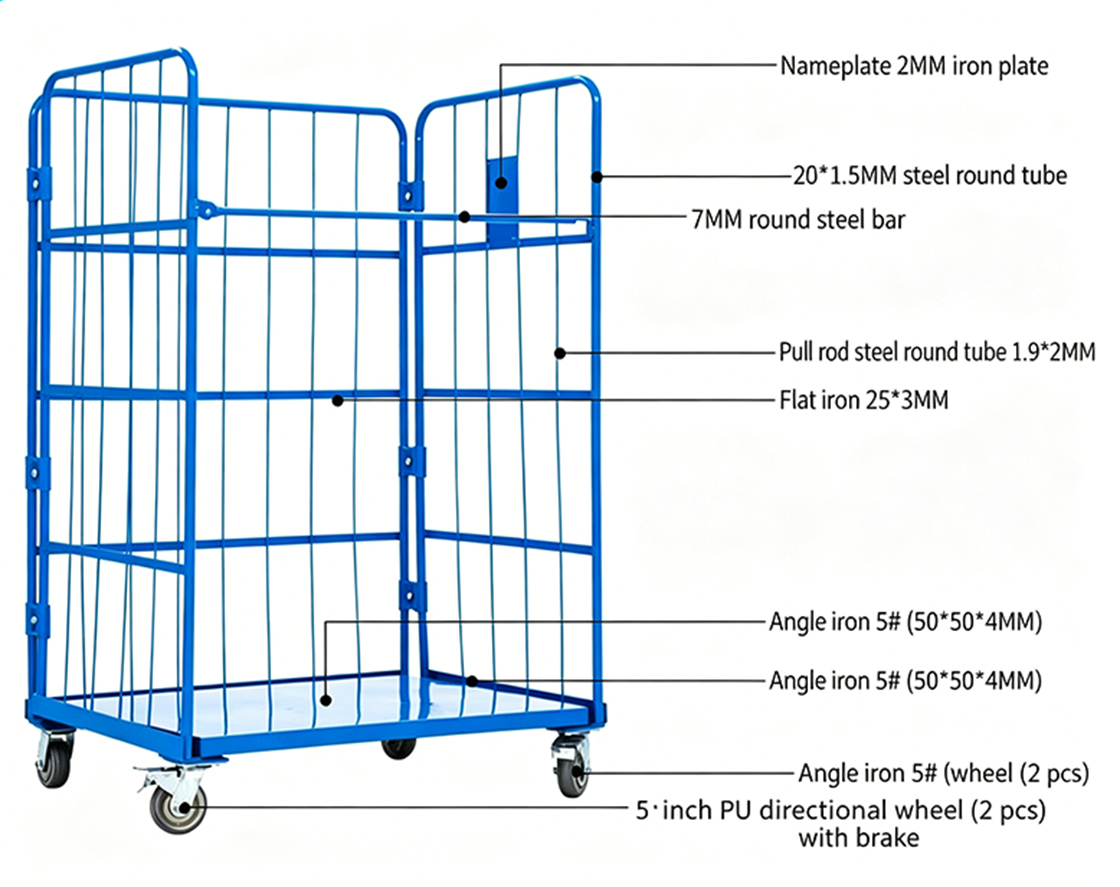
I. An essential tool for material handling in the logistics and manufacturing sectors, enabling maximum utilization of production line space.
II. Facilitates streamlined production planning, saves labor, and reduces costs to achieve high productivity and superior quality.
III. The leading solution for product handling, ensuring the safety and reliability of both personnel and goods during transit.
IV. Features ample storage capacity and flexible application; designed to be foldable for compact storage, occupying minimal space.
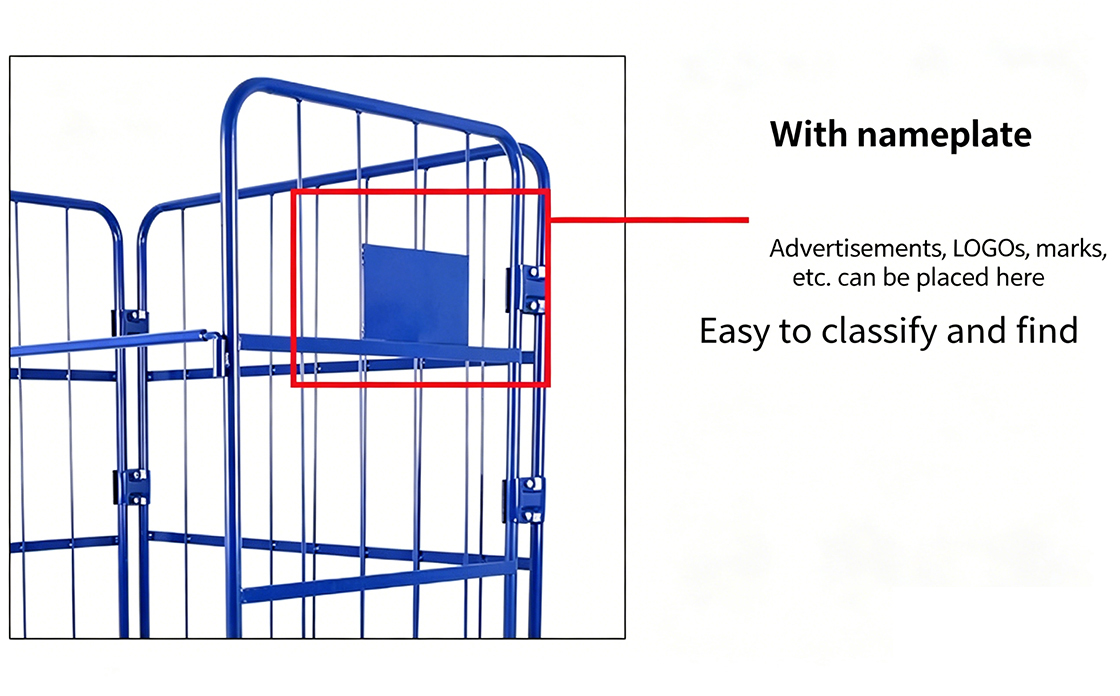
V. Equipped with a labeling plate to clearly define operational procedures; offers lightweight handling, agile maneuverability, and simple operation.
VI. Boasts high mobility, an aesthetically pleasing structure, and an electrostatic powder-coated surface finish for exceptional durability and a long service life.
VII. Can be fitted with safety straps and quick-release securing bars for rapid loading and unloading; capable of serving as a continuous transport unit—moving directly from the facility onto delivery vehicles—and is foldable for space-saving storage and convenient transport.
VIII. Professionally engineered for ease of use, saving both time and labor. Widely utilized across the logistics, distribution, and manufacturing industries. An indispensable choice for handling small items, serving multiple functions including transport, storage, and product display.
Can be quickly folded or unfolded without the need for tools; occupies minimal space when not in use, facilitating easy storage and transport.
Offers multi-level storage space with fences that can be removed as needed, accommodating goods of various sizes and heights for flexible application.
Equipped with silent swivel casters that allow for noise-free movement without damaging floor surfaces; select models feature brakes for safer parking.
Features a comfortable push handle and rounded corners to prevent scratching of goods or injury to the operator.
Designed with standardized specifications; units can be stacked when empty to facilitate centralized management and are suitable for circulation across various operational scenarios.
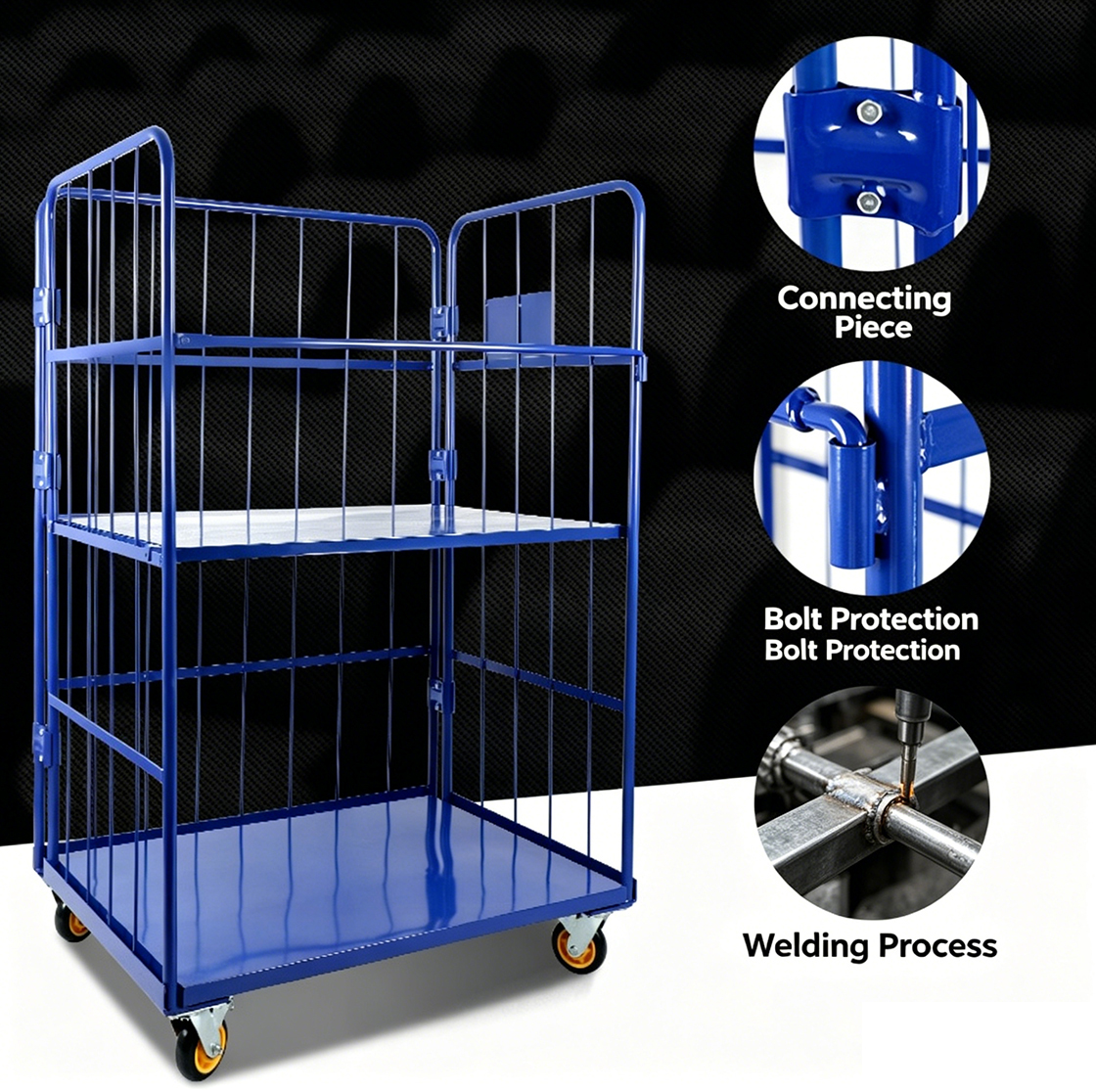
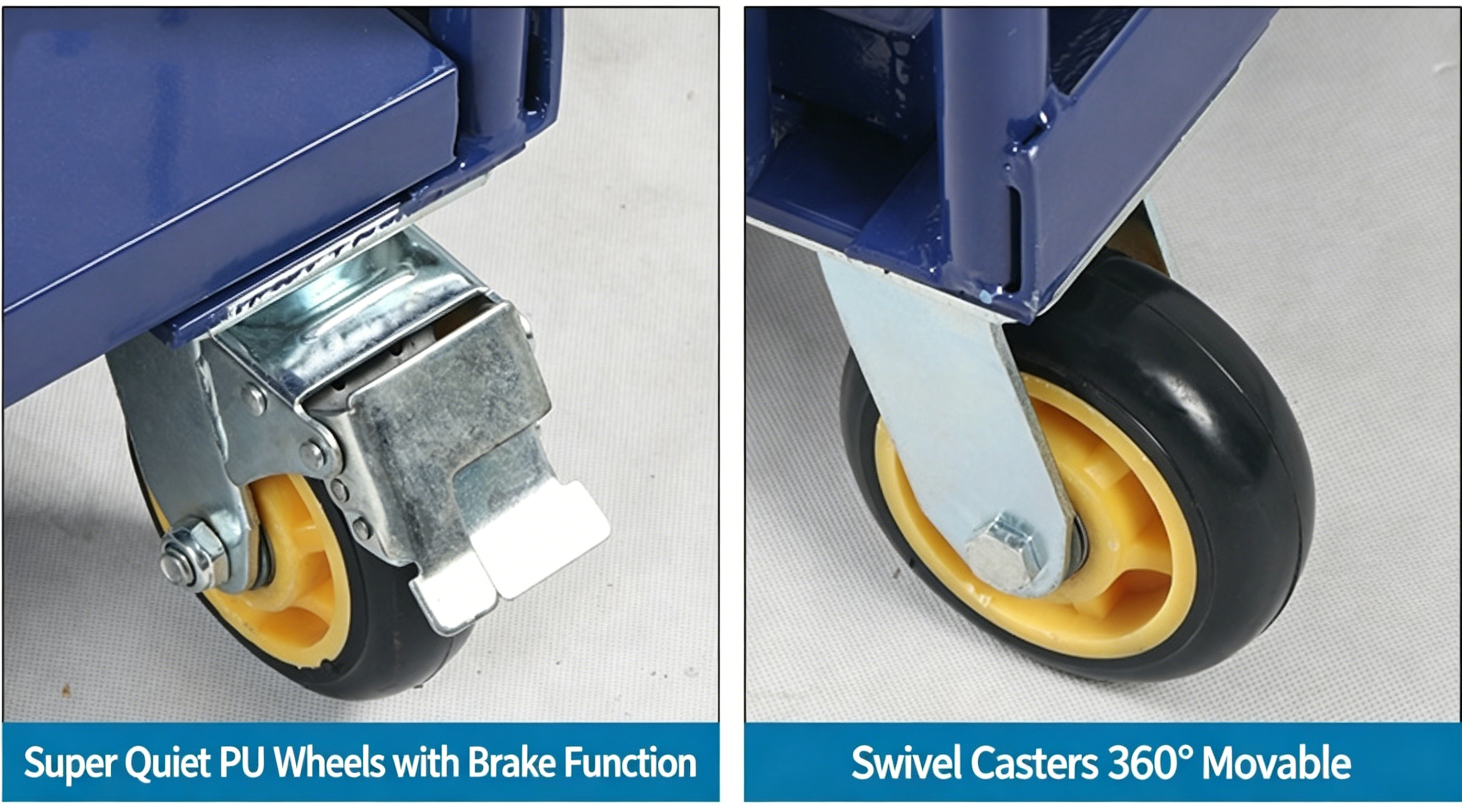
Constructed from thickened cold-rolled steel tubing and wire framing; the material is robust, highly resistant to bending and compression, and offers exceptional load-bearing capacity.
Utilizes fully automated welding techniques to ensure strong, solid weld points free of defects; the overall structure remains stable and resistant to cracking even after prolonged use.
The surface undergoes electrostatic powder coating and galvanization treatments, resulting in a smooth, wear-resistant finish that is rust-proof and corrosion-resistant, making it suitable for diverse warehouse environments.
Swivel casters allow for flexible steering and feature integrated braking mechanisms to ensure non-slip parking and precise positioning, thereby enhancing operational safety.
Features a reinforced bottom crossbeam design that distributes weight evenly, preventing structural deformation under heavy loads and ensuring stability during the handling of heavy goods.
Select models feature a modular design that allows for disassembly and reconfiguration, facilitating more convenient transport and storage, as well as simple maintenance. Logistics Cart Technical Specifications and Materials List
| External Dimensions | Material |
| 800*600*1450 | The material is Q235. |
| 800*600*1700 | |
| 850*650*1700 | |
| 950*800*1700 | |
| 1100*800*1700 | 50x50 Angle Steel | 25x1.5 Round Tube | 3x25 Flat Bar | 7mm Threaded Rod | Shelf Panels: 1.0mm & 2.0mm | 5-inch PU Casters [2 Swivel, 2 Swivel with Brakes] | Load Capacity: 500 kg |
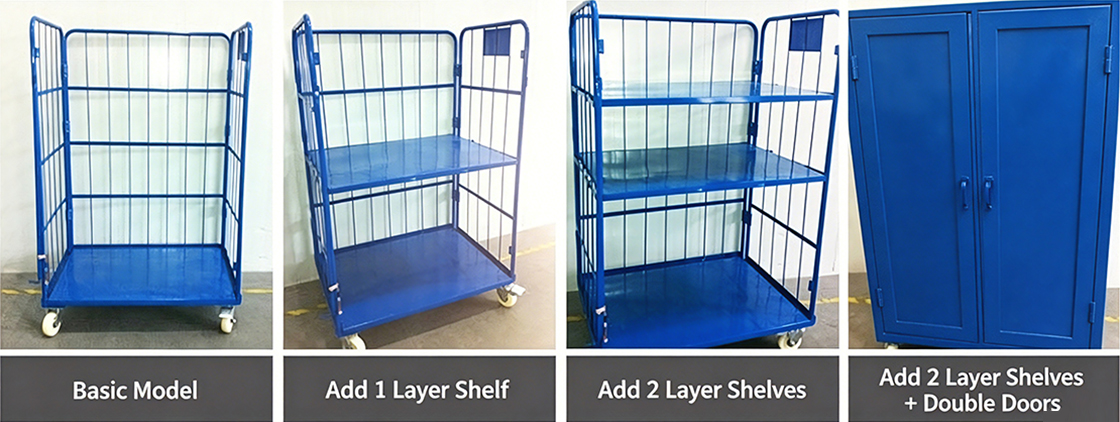
| Shelves and doors can be added depending on the specific model; non-standard customization is supported. | |
Main Frame | Dimensions: Customizable (Common: 1200×800×1900 mm) | Structure: Welded, reinforced frame | Load Capacity: Rated load 500–800 kg | High-quality cold-rolled steel plate (Q235B); formed via bending and welding; surface treated with anti-rust powder coating.
Fencing/Side Panels | Height: 300–600 mm (Optional) | Structure: Mesh or solid-panel fencing (Detachable) | Cold-rolled steel plate (Thickness: 1.0–1.5 mm); surface treated with electrostatic powder coating for corrosion and rust resistance.
Caster Configuration | Type: Swivel casters + Fixed casters | Diameter: 50 mm / 75 mm / 100 mm | Brakes: Integrated braking mechanism | Load Capacity: Single-wheel load ≥ 200 kg | Casters: High-strength Nylon + Polyurethane (PU) material | Axles: Chrome-plated carbon steel; wear-resistant and scratch-proof.
Push Handle | Design: Ergonomic curved handle | Position: Side / Rear (Optional) | Material: Wrapped, anti-slip design | Body: Cold-rolled steel plate | Grip: TPR anti-slip rubber; comfortable tactile feel and non-slip grip.
Folding Structure | Folding Method: One-touch fold/unfold | Folded Thickness (Unloaded): ≤ 150 mm | Stacking: Multi-layer stacking possible when unloaded | Connecting Components: High-strength spring steel + wear-resistant alloy pins; ensures smooth and durable folding operation.
Surface Treatment | Process: Acid pickling – Phosphating – Electrostatic powder coating | Color: Customizable (Common: RAL 7032 Grey, RAL 9002 White) | Coating Thickness: 60–80 μm | Powder Coating: Eco-friendly epoxy resin powder; features strong adhesion, scratch resistance, and fade resistance.
Overall Performance | Service Life: ≥ 5 years (under cyclic use) | Impact Resistance: Withstands frequent collisions associated with industrial handling | Water & Rust Resistance: Suitable for use in humid warehouse and workshop environments. The unit is primarily constructed from Q235B cold-rolled steel, supplemented by rust-resistant aluminum alloy connectors, ensuring an optimal balance between structural strength and corrosion resistance.
Used for the short-distance transfer of workshop materials, semi-finished goods, and spare parts; facilitates back-and-forth distribution between workstations and categorized storage, thereby boosting production line efficiency.
Supports stock preparation, order picking, replenishment, and general organization of goods; lightweight and agile, making it ideal for high-frequency daily turnover within warehouse zones.
Facilitates the centralized collection, sorting, temporary storage, and transfer of express shipments, parcels, and small items; designed for convenient loading/unloading and efficient workflow.
Used for store replenishment, product display stocking, and back-room inventory organization; features silent casters that protect flooring surfaces and ensure quiet operation.
Handles the transport of packaged goods, daily necessities, and food ingredients; features a clean, dust-resistant design with protective side rails to prevent items from falling.
Supports order picking, packing turnover, and centralized distribution of small items; features a collapsible design for compact storage, ensuring it occupies minimal space when not in use.
Features a moisture-proof and rust-resistant structure suitable for low-temperature and humid environments, used for the turnover and transport of fresh produce and refrigerated goods.
Used for transporting supplies, storing cleaning tools, and moving office equipment; lightweight, user-friendly, and suitable for a wide range of applications.
1. Place goods evenly to ensure the center of gravity remains centered; avoid off-center loading, stacking items too high, or allowing goods to protrude beyond the cart's protective rails.
2. Place heavier items on the bottom shelf and lighter items on the upper shelves to prevent tipping or items falling off.
3. When fully loaded, do not exceed the cart's rated load capacity; overloading is strictly prohibited.
1. Release the brakes, grasp the handlebars with both hands, and push the cart smoothly and slowly; strictly avoid sudden forceful pushes, sharp turns, or allowing the cart to coast at high speeds. 2. Slow down when crossing thresholds, ramps, or corners to prevent jolting or tipping over.
3. Standing on, climbing on, or riding the trolley is strictly prohibited.
1. Immediately engage the brake after parking to secure the trolley and prevent it from rolling or sliding.
2. Park on level ground; do not stop or leave the trolley unattended on slopes.
1. Folding operations must be performed while the trolley is unloaded; folding while carrying goods is strictly prohibited.
2. Follow the designated latching steps to collapse the side rails and fold the trolley body; perform these actions gently to avoid pinching your hands.
3. Stack the folded trolleys neatly to maximize warehouse space efficiency.
1. When transferring goods using forklifts or pallet jacks, ensure proper alignment for a smooth lift; avoid forceful impacts or prying motions.
2. When multiple people are involved in moving the trolley, designate a single person to give commands to prevent collisions involving personnel or shelving units.
1. Do not drag the trolley violently or allow it to collide with walls or shelving units.
2. Regularly inspect the casters, brakes, weld points, and side rails; repair any damage immediately.
3. Keep the trolley dry; avoid prolonged exposure to rain or damp environments to prevent rust.
- Causes: Casters are jammed, debris is entangled in the wheels, wheel axles are rusted, or wheels are worn/deformed.
- Solutions: Regularly clear debris from between the wheels; apply lubricant to the axles; replace severely worn casters immediately; prioritize the use of quiet, wear-resistant PU casters.
- Causes: Overloading, prolonged use on uneven surfaces, violent dragging, or impacts/collisions.
- Solutions: Strictly prohibit overloading; use the trolley on level ground whenever possible; avoid forceful pulling or dragging; regularly inspect the wheel bodies and bearings.
- Causes: Worn brake pedals, failed springs, or aged/jammed wheels.
- Recommendation: Always engage the brake when parking; regularly inspect brake components; promptly replace damaged parts to prevent runaway accidents.
- Causes: Excessive or uneven loading; impact with shelving units; rough handling; prolonged compressive stress.
- Recommendation: Distribute cargo evenly to avoid unbalanced loads; handle with care to minimize impacts; re-weld and reinforce detached joints; downgrade the usage of deformed trolleys.
- Causes: Worn latches; insufficient spring tension; improper latch engagement.
- Recommendation: Ensure all latches are securely fastened after loading; straighten or replace deformed latches; take measures to prevent cargo from falling.
- Causes: High warehouse humidity; standing water; prolonged exposure to rain; scratches or damage to the paint surface.
- Recommendation: Maintain a dry storage environment; avoid outdoor storage; touch up damaged areas with anti-rust paint; opt for galvanized models in humid environments.
- Causes: Deformed folding hinges; accumulation of dust and rust; component misalignment.
- Recommendation: Perform folding operations only when the trolley is unloaded; clean debris from hinges and lubricate them regularly; straighten and repair deformed components.
- Causes: Excessive stacking height; shifted center of gravity; lack of protective barriers; disorderly stacking.
- Recommendation: Observe stacking height limits; place heavier items at the bottom and lighter items at the top; arrange cargo neatly; use wrapping or strapping to secure large or loose items.
