
 News
Views: 0 Author: Site Editor Publish Time: 2026-08-31 Origin: Site


Operations often grind to a halt when rigid warehouse infrastructure meets volatile demand. Traditional fixed racking frequently fails to adapt to seasonal fluctuations, irregular inventory, or sudden layout changes. This limitation leaves you scrambling to accommodate unexpected fulfillment bottlenecks. Enter the Stacking Rack. You should view this not merely as a basic storage product, but as a dynamic logistics asset. It specifically designs out wasted space and directly reduces handling delays. This article objectively evaluates how these modular systems solve distinct storage constraints. We will analyze the immediate financial implications of adopting portable storage. Finally, we provide a structured framework to help you shortlist the exact system your facility needs right now.
Stacking racks convert temporary dead space into high-density storage without permanent installation costs.
Selecting between an Insert-Tube Stack Rack, Collapsible Stack Rack, or Fixed Stacking Rack depends strictly on your off-season storage footprint and load requirements.
Compared to traditional pallet racking, stacking racks offer higher layout flexibility but require specific operational safety protocols regarding floor limits and forklift access.
The primary ROI driver is the prevention of off-site storage rentals during peak inventory seasons.
Fixed racks create a rigid footprint. During off-seasons, they leave you staring at empty aisles and wasted real estate. Conversely, peak seasons quickly overwhelm this static capacity. Stacking racks eliminate this flexibility gap entirely. They allow you to build temporary high-density staging areas on demand. Once the seasonal rush fades, you simply dismantle or nest the racks. This instantly reclaims your floor space for other profitable operations.
Standard pallet racks handle uniform loads beautifully. They struggle immensely when handling non-palletized, crushable, or awkwardly shaped items. Think of tires, long pipes, or rolled textiles. These items hang off pallets or crush underlying goods. A modular racking system surrounds and protects these irregular items. The rack frame bears the weight, not the product below. This prevents product damage and maximizes vertical airspace for awkwardly shaped inventory.
Permanently anchored racks represent a massive sunk cost. You pay to engineer them, permit them, bolt them down, and eventually dismantle them. If your company relocates, moving traditional racking proves labor-intensive and expensive. Portable racks completely bypass this bottleneck. You simply pick them up and move them. They function as portable assets rather than permanent building fixtures. This mobility grants warehouse managers ultimate layout freedom.
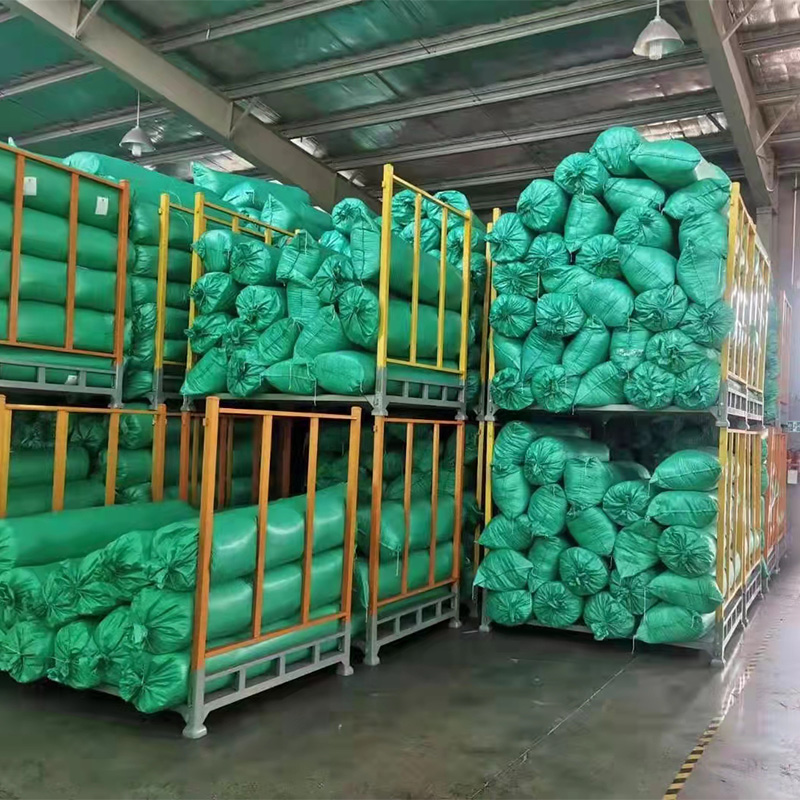
Selecting the correct modular system requires matching the rack profile to your daily workflow. Below, we examine the four primary designs and their optimal environments.
Profile: This design features a strong base and completely removable corner posts. Operators slide these metal tubes into target sockets.
Use Case: The Insert-Tube Stack Rack works best for facilities prioritizing complete teardown capability. You can easily swap out different post lengths to accommodate varying load heights. This makes it perfect for agricultural storage, seasonal retail, and 3PL providers managing unpredictable client goods.
Profile: These racks utilize hinged sides or bases. They fold down flat into a compact footprint when empty.
Use Case: You will find the Collapsible Stack Rack ideal for returnable shipping applications. It shines in closed-loop supply chains and cross-docking operations. When empty, folded racks ship back to the origin point compactly. This drastically cuts reverse logistics freight costs.
Profile: This variation offers a fully welded, non-removable structure. It sacrifices collapsibility for pure structural rigidity.
Use Case: The Fixed Stacking Rack excels in heavy industrial manufacturing. High-load capacities demand permanent welds. If your facility stores dense metal castings or heavy machinery parts, durability outweighs off-season space-saving. They withstand rough handling better than any modular counterpart.
Profile: These specialized units combine rigid steel frames with suspended textile bags or compartmentalized dunnage.
Use Case: The Fabric Stacking Rack protects sensitive parts. Automotive manufacturers frequently use them for painted bumpers or delicate dashboard components. The suspended fabric prevents part-to-part contact. It also supports highly customized part sequencing directly to the assembly line.
Every facility eventually faces a choice between permanent aisles and modular blocks. Understanding the trade-offs ensures you deploy capital efficiently.
Traditional pallet racks demand significant upfront investment. You must pay for structural engineering, building permits, and specialized installation crews. A portable stacking system bypasses these delays. You can order them, unload them, and deploy them on the same day. This immediate deployment eliminates installation downtime and accelerates your operational readiness.
Traditional narrow-aisle racking dominates in vertical density. If you need to access individual pallets constantly, fixed racks win. However, stacking racks dominate block-stacking scenarios. By eliminating forklift aisles entirely, portable racks utilize your absolute maximum square footage. You stack them deeply into blocks, which perfectly suits high-volume, low-SKU inventory.
If demand shifts suddenly, altering traditional racking requires heavy labor. You must empty the racks, unbolt them, reposition them, and re-anchor them. Modular systems adapt dynamically. You can change your warehouse layout on a Tuesday afternoon using just one forklift operator. This scalability prevents workflow congestion during sudden demand spikes.
Operational Comparison Matrix
Feature | Modular Stacking System | Traditional Pallet Racking |
|---|---|---|
Installation Speed | Immediate (No assembly required for fixed/foldable models) | Weeks (Requires engineering, permitting, and labor) |
Aisle Requirements | None (Supports deep block stacking) | High (Requires dedicated aisles for every row) |
Portability | High (Can be relocated or shipped instantly) | Low (Anchored to facility concrete) |
Individual SKU Access | Low (Must move top racks to reach bottom racks) | High (Every pallet remains independently accessible) |
Many operations rent short-term 3PL overflow space during peak seasons. These external leases destroy profit margins. You pay for external floor space, additional freight routing, and redundant handling. Purchasing modular racks allows you to maximize your existing building first. Converting empty dock space or wide aisles into temporary high-density storage often pays for the racks in a single peak season.
Modular racks drastically cut down material handling time. Consider standard picking operations. Workers normally pick individual units from fixed racks, place them on a pallet, and wrap it. With a portable system, the forklift moves the entire loaded rack directly to the shipping dock. Consolidating the storage unit and the transport unit eliminates repetitive touches.
Financial departments favor modular systems for tax and asset reasons. Tax codes generally classify traditional anchored racks as permanent building fixtures. This usually mandates a long depreciation schedule. Conversely, authorities classify portable racks as equipment or returnable packaging. This often allows for much faster depreciation. Furthermore, if you lease your warehouse, you retain your storage assets completely when moving out.
Do not underestimate concrete point-load stress. When you stack heavy units four to five tiers high, massive weight transfers down. All that weight concentrates on four relatively small corner feet. You must verify your warehouse floor's slab thickness and PSI rating. Overloading a standard concrete slab causes severe cracking, sinking, and potential catastrophic rack failure.
Block stacking requires distinct operator skills. Drivers must lift loads up to 20 feet high and align small target bases onto corner posts. Misalignment poses a significant safety risk. You must allocate time for specific operator training. Drivers need to learn proper tilting, approach speeds, and target alignment techniques to stack safely at maximum heights.
Portable equipment bypasses some building permits, but OSHA and local equivalents still enforce strict safety guidelines. You must ensure every rack features clear load-rating labels. Never exceed the manufacturer's maximum weight limit. Additionally, establish a routine inspection protocol. Check for weld fatigue, bent posts, or deformed bases, removing damaged units from rotation immediately.
Choosing the exact setup requires a systematic approach. Follow these distinct steps to narrow down your options.
Audit Your Load Requirements: Determine the absolute maximum weight and dimensions of your typical load. Heavy, consistent loads point toward welded fixed solutions. Variable heights demand insert-tube options.
Calculate Off-Season Footprint: Evaluate how much empty space you can afford. If floor space sits at an absolute premium during off-seasons, bias your selection heavily toward collapsible or tube-style designs.
Assess Handling Equipment: Check your current forklift fleet. Verify their maximum safe lift height. Ensure they possess the required load capacity at that extended height. Finally, confirm the fork spread matches the target rack bases.
Next Steps: We highly recommend requesting a prototype before committing to a massive purchase. Run a small-scale pilot using one bay or a single block-stack lane. This allows your operators to test alignment speed and verify floor space savings in real-time.
Modular racking systems do not serve as a wholesale replacement for traditional permanent racks. Instead, they act as a strategic supplement. They handle demand volatility, irregular bulk items, and sudden layout changes better than any fixed infrastructure. By deploying these systems, you directly address the flexibility gap that plagues modern fulfillment centers.
Operations managers must objectively measure their current layout downtime. Calculate your recurring external overflow costs. Compare those numbers directly against the immediate upfront cost of portable storage. The financial justification usually becomes obvious quickly.
Stop letting rigid warehouse structures dictate your growth. Contact a certified storage engineer today. Request a custom quote based strictly on your unique weight capacity and off-season footprint constraints to reclaim your facility's efficiency.
A: The safe stacking height depends strictly on the base dimensions, load weight, and manufacturer specifications. Most standard industrial environments safely stack these units 4 to 6 tiers high. Always consult the manufacturer's load-rating label, as pushing beyond the engineered tier limit risks a catastrophic tipping hazard.
A: Usually, no. Unlike traditional pallet racks bolted to the concrete, local building codes generally classify portable racks as temporary equipment or returnable packaging. However, you must still adhere to OSHA safety standards regarding floor load limits and safe stacking heights.
A: Yes. Many facilities use them for outbound logistics, especially in closed-loop supply chains. Foldable or tube-style models work best here. They protect goods during transit and easily collapse when empty, minimizing reverse logistics freight costs on the return trip.
A: You prevent crushing because the rack design isolates the product. The corner posts and steel frame bear 100% of the weight from the tiers above. The load transfers directly through the structural posts to the floor, ensuring the actual products never touch or compress each other.


