
 News
Views: 0 Author: Site Editor Publish Time: 2026-10-19 Origin: Site


Pallets often function as disposable commodities in busy distribution centers. Yet, sudden pallet failure remains a leading cause of severe supply chain disruptions, costly product damage, and unexpected automation downtime. You might not notice them until a broken runner jams your entire conveyor line.
Transitioning from traditional wood or plastic to robust metal requires justifying a higher initial capital expenditure against long-term operational efficiency. Facility managers must evaluate equipment durability to eliminate ongoing replacement cycles that silently drain budgets. We must look beyond the initial purchase price to understand actual performance limits under heavy stress.
We will explore when upgrading to metal infrastructure becomes an operationally sound decision for high-demand facilities. You will learn about automation reliability, critical hygiene compliance, and unparalleled extreme load capacities. We will also outline the implementation realities you need to anticipate for a successful rollout.
Automation Reliability: Rigid dimensions prevent the deflection and structural inconsistencies that cause catastrophic jams in Automated Storage and Retrieval Systems (ASRS).
Compliance and Hygiene: Non-porous surfaces naturally bypass ISPM 15 export regulations and eliminate contamination risks in pharma, food, and chemical logistics.
Load Capacities: Offers unparalleled static and dynamic load ratings, maximizing high-bay racking utility without structural bowing.
Wood pallets break down rapidly under heavy daily use. They splinter, crack, and lose nails. We constantly sort, repair, and discard them. This repetitive cycle consumes massive amounts of labor hours. You lose productivity every time a worker stops to sweep up broken wood. Over a single year, the compounding cost of replacing damaged units deeply impacts facility budgets. We often accept this maintenance drain as a normal operating expense, but it actually masks deep operational inefficiencies.
Organic materials absorb moisture like a sponge. Wood soaks up chemical spills, cleaning fluids, and organic waste. Pests easily hide inside the porous grain. To combat this, international shipping rules require chemical or heat treatments. These ISPM 15 regulations create severe bottlenecks in export logistics. Furthermore, cleanrooms in pharmaceutical and food manufacturing simply cannot tolerate wood dust. Splinters and airborne particles present massive contamination risks. Failing a compliance audit due to dirty equipment stops operations entirely.
Automated conveyors and robotics demand absolute perfection. Automated Storage and Retrieval Systems (ASRS) operate on millimeter tolerances. Wood sags under heavy loads. Plastic warps over time. When a loaded deck deflects downward, it triggers sensitive photo-eye sensor faults. Protruding nails catch on conveyor rollers. Loose splinters jam mechanical gears. These structural inconsistencies cause catastrophic jams. Every automated shutdown requires an engineer to manually clear the blockage. This ruins your daily throughput metrics.
Warehouses face increasingly strict fire safety codes. Wood and plastic represent highly combustible materials. Storing thousands of organic units dramatically increases the total fire load of your building. Plastic burns extremely hot and releases toxic smoke. Fire marshals evaluate these risks carefully. High combustible material volumes directly impact safety compliance. You might face raised commercial insurance premiums simply because of your storage infrastructure. Removing flammable materials lowers your overall risk profile.
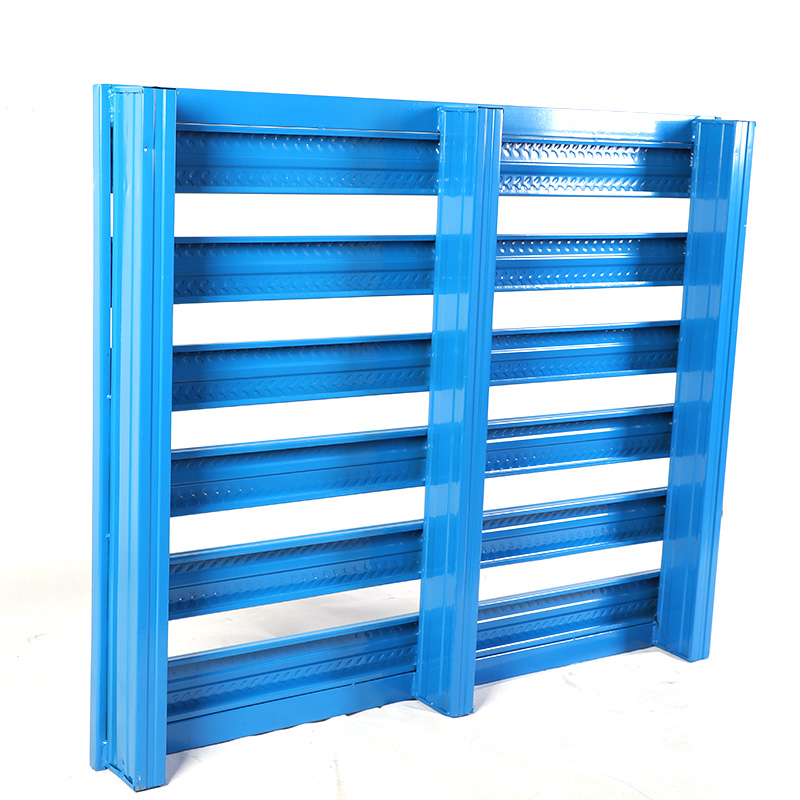
Metal maintains absolute rigidity under multi-ton loads. We can map the structural integrity of a Steel Pallet mathematically. It does not bow in the center when placed in high-bay racking. This deflection-free performance secures high-density vertical storage. You can confidently store heavy engine blocks or dense liquid totes high above the warehouse floor. Superior dynamic load ratings mean the unit stays perfectly flat even while moving on a forklift. This prevents load shifting and catastrophic product drops.
Precision manufacturing guarantees uniform tare weights. Every unit rolling off the assembly line measures exactly the same. They possess dimensional exactness. This ensures zero sensor disruption in automated handling environments. Conveyor rollers move them smoothly. ASRS cranes grip them precisely every single time. They never sag, warp, or change shape. Your robotic systems run continuously without annoying sensor faults. This synergy maximizes the heavy capital investments you already made in warehouse automation.
Metal naturally bypasses restrictive global shipping regulations. It is inherently exempt from ISPM 15 rules. You never need to secure expensive fumigation certificates. Heat treatment stamps become irrelevant. Customs agents clear metal infrastructure rapidly. This eliminates cross-border quarantine delays completely. Your international shipments arrive on time without regulatory friction. For global supply chains, removing compliance paperwork speeds up the entire distribution network.
Harsh environments destroy conventional materials quickly. Plastics shatter in sub-zero blast freezers. Wood degrades under harsh chemical washdowns. Metal resists extreme temperature fluctuations effortlessly. You can move them directly from freezing cold storage rooms into high-heat industrial curing ovens. They survive rigorous sanitation protocols. We clean them easily using harsh washdown chemicals and high-pressure steam. The structural integrity remains intact regardless of the environmental abuse they take daily.
Capital justification is strongest in closed-loop supply chains. In a closed loop, you send assets out and guarantee they return. Internal facility transfers represent perfect use cases. You move goods between your own manufacturing plant and your own distribution center. Highly regulated industries like pharma and food processing also benefit massively. Asset retrieval is guaranteed in these tight networks. Open-loop shipping, where assets vanish into the retail market, makes heavy infrastructure investments difficult to justify.
You must compare the upfront unit cost against a 10-to-15-year lifecycle. Wood is cheap initially but dies quickly. Metal demands a higher initial Capital Expenditure (CapEx). However, it operates with near-zero maintenance. We eliminate sorting labor, repair costs, and disposal fees. Over a decade, the financial model shifts dramatically. You buy them once and use them thousands of times. Facility managers must look strictly at operational longevity to understand the true financial picture.
Different industries extract different values from heavy-duty infrastructure. We must evaluate necessity based on specific use cases.
Automotive Manufacturing: Heavy stamping operations require massive structural strength. Engines and transmissions crush standard equipment.
Chemical Logistics: Hygienic transport prevents dangerous cross-contamination. Leaks wipe clean off metal surfaces.
Pharmaceuticals: Cleanrooms demand zero particulate generation. Metal eliminates dust and biological harbor points.
Cold Chain: Temperature integrity requires materials that do not become brittle in deep freezes.
Material Performance Comparison Chart
Feature | Wood | Plastic | Metal |
|---|---|---|---|
Static Load Capacity | Medium (Up to 3,000 lbs) | High (Up to 10,000 lbs) | Maximum (10,000+ lbs) |
Deflection Risk in ASRS | High | Medium to High | Zero |
ISPM 15 Exemption | No (Requires Treatment) | Yes | Yes |
Maintenance Needs | Constant | Low | Near-Zero |
Metal weighs significantly more than standard wood. A robust unit can weigh between 60 and 80 pounds. You must assess this impact on truck payload limits. Department of Transportation regulations strictly govern maximum vehicle weights. Heavier tare weights mean you can pack less actual product into a trailer before hitting weight limits. Therefore, heavy materials are typically less suited for outbound, one-way freight where weight directly equals fuel costs and shipping fees.
Heavier tare weights change facility dynamics. We must verify our forklift fleet capacities. Lifting a stack of twenty metal units requires serious hydraulic power. We also need to assess potential wear on untreated concrete floors. Dragging heavy metal across a warehouse floor creates deep scratches. It degrades epoxy floor coatings. Facility managers should equip pallet jacks with softer polyurethane wheels. Operators must learn to lift completely before moving to prevent floor gouging.
Unfinished steel will eventually rust. Procurement teams must evaluate and specify the correct surface treatments. Hot-dip galvanizing provides excellent protection for wet or outdoor environments. The zinc coating bonds chemically to stop rust aggressively. Powder coating offers a great solution for indoor purposes. It bakes a hard paint layer onto the surface. You can use powder coating for visual identification, color-coding distinct inventory zones across a large facility.
Metal-on-metal contact increases ambient warehouse noise. When forklift tines strike a metal deck, it echoes loudly. Stacking them together creates sharp clanging sounds. This acoustic shift requires updated handling protocols for all forklift operators. You must train drivers to place loads gently rather than dropping them. Some facilities implement noise-dampening pads on forklift carriages. Managing the acoustic environment keeps warehouse workers comfortable and focused.
You face a choice between 2-way and 4-way entry designs. We select 2-way entry models when we need absolute maximum load capacities. The internal support beams run solidly from end to end without interruption. Conversely, 4-way entry designs provide maximum handling flexibility. Forklifts can grab them from any side. This proves essential in tight aisles and crowded loading docks. You must match the entry design to your specific racking layout and equipment fleet.
Deck styles dictate functionality. We choose open or slatted decks for specific reasons. Slats allow air to flow freely, which is ideal for blast freezing operations. They also drain water instantly during harsh washdowns. Solid decks serve a completely different purpose. They prevent small components, screws, or liquid spills from falling through to the levels below. Solid tops are easier to wipe down manually but lack airflow.
Surface treatments determine lifespan. Galvanized finishes offer maximum rust prevention. The food industry often requires galvanization to maintain strict FDA compliance in wet environments. Painted or powder-coated finishes allow precise visual management. You can color-code your fleet effortlessly. Blue units belong to cold storage. Red units stay in the quarantine zone. This visual logic prevents cross-contamination and keeps inventory physically separated.
Standard footprints keep upfront costs reasonable. They fit seamlessly into standard pallet racking systems. However, some manufacturing processes produce massive, unusually shaped items. In these cases, we evaluate the premium of custom engineering. A custom-built unit supports specialized payloads perfectly. It secures awkward center-of-gravity loads. We must balance the higher cost of custom fabrication against the ready availability of standard dimensional profiles.
Standardizing your facility on metal represents a serious infrastructure investment. It is not a simple packaging purchase. By moving away from disposable materials, high-demand facilities unlock superior safety, seamless automation, and guaranteed regulatory compliance.
To move forward effectively, consider the following action steps:
Map a specific closed-loop segment within your facility where assets never leave your control.
Launch a limited pilot program using a small batch of metal units in your harshest environment.
Measure operational longevity, automation uptime, and sanitation efficiency over a 90-day period.
Compare these operational metrics against your baseline wood failure rates before authorizing a full fleet rollout.
A: When utilized in normal warehouse conditions, metal units routinely last 10 to 15 years. They outlive standard wood alternatives by a massive margin. Wood typically survives only a few months before requiring significant repairs or total disposal. Metal easily handles daily abuse without structural degradation.
A: Yes, they are entirely exempt. ISPM 15 regulations specifically target organic materials that can harbor dangerous pests and insects. Because pests cannot eat or live inside metal, customs agencies worldwide do not require heat treatment stamps or chemical fumigation certificates for metal shipping equipment.
A: A heavy-duty metal unit generally weighs between 60 and 80 pounds, depending on the material gauge and deck configuration. Standard wood typically weighs 40 to 50 pounds. This heavier tare weight directly reduces the total payload weight you can legally load into a commercial shipping trailer.
A: Yes, they are highly repairable. Unlike shattered plastic, bent metal can be safely straightened. Broken welds can be ground down and re-welded in any standard fabrication shop. This repairability extends their useful life significantly, preventing the need for total unit replacement.


